Alister McGrath says in his introductory chapter The landscape of faith of ‘Mere Theology’ (2010) that a theological reading of the Eucharist can be made under four headings (retrospective, anticipation, affirming faith & affirming belonging), going on to make this a case study of what thinking theologically looks like. I am struck that this is not a trivial claim: the sacramental understanding of the Eucharist is that it is the moment at which Church is born. The unity of God in Christ with his human disciples is announced at the Last Supper in the Upper Room and underlined with cosmic drama at the Supper in Emmaus. These accounts are the basis of our ongoing celebration of The Lord’s Table, a drawing forward into our present of the creative moment that is enacted before and after the crucifixion and resurrection. The power of that first Creation is recreated in our continuing Holy Communion- a Providential sustaining of what was first declared over the ‘mere’ elements of bread and wine. So I was paying attention when McGrath laid out his four-fold analysis. I agree that this simple framework does justice to assessing the weight of meaning in the Eucharist. His schema strikes me as apposite to ongoing reflections on the meaning of Genesis 1-4.
Retrospective.

Looking to the past. The Eucharist looks back to Passover and beyond to the liberation of Israel from oppression. The Exodus is the Creation of the People of God. What does Genesis look back to? In the beginning God. Not stuff or space or any dimension of human history and life. Before all and everything is God. Only once this is perceived can any of the following statements in Genesis 1 be made sensible. Earth, water, sky, heavens, plants and creatures, and then humans in Imago Dei. These are indeed the subjects of the opening creation account, but they are not the focus. God is. Sure, the opening chapter does have the stuff of created things in clear view, but what the theological lens really focuses on is the foundational assertion of God; and only then does it make sense to read forward from this assertion of the sovereign God who is real can we then have confidence that this real God (against all alternatives which are merely the fruit of fantasy, or deception) is the Creator of all that is real, the One who has the vital power of Providence and therefore hold our entire life and being securely.
Anticipation.

Looking forward: for the Eucharist, to the Final Return of God to unity in full experience, the Head Who is Christ joined with Christ’s Body, which is all the saints of God through history past and future. The whole Genesis account is held in the frame of the creation week, and it is in this matrix that I put the answer that Genesis looks forward to the seventh Day, the Sabbath Rest of God, which is presented here in embryo and only given partial gestation through the balance of Scripture, especially in Hebrews and Revelation. In Genesis we are alerted by the temporary halt between the sixth and then the seventh Days. (Note that the pause happens to be near to the chapter division between Gen 1 and Gen 2, but this is coincidental. What I say is a ‘pause’ is in the Hebrew text at 2:1, and then given substance at 2:2-3.) In this heavy hint is the foundation of the theological principle now but not yet. In the tension between our having fallen short of the glory of God, in this life of perseverance and pain, and the life of the world to come is a realisation of hope rather than tragedy. In the promise of a glorious Sabbath to come is an assurance that we will know more of the mercy of God than God’s judgement. What will become evident later in the New Testament is the New Creation. While that reality waits for later, it is still implicit in the terms of Genesis 2 that what God did at the beginning (and sustains through Providence) is not all that pertains to Creation. Creation has started, as God determined; creation continues through salvation history and Providence; and Creation is not yet completed, for there will be more- a New Creation.
So the Creation properly begins with God, and therefore emphatically prior to any notions of Science or History. Thus I state positively what Claus Westermann states in the negative (Creation, 1974). How could we humans know anything of the Beginning? Westermann asserts this is a futile ambition. But God self-reveals in this first Revelation in Genesis. God declares as the First, the ground of all Being and Becoming, the First Person of Creation, Creator. This is not all, and perhaps Westermann missed something. While we can know less of the start of creation than we would wish, from the vantage point of the New Testament, we already know more of the New Creation than we could dare to wonder about.
Affirming faith

Thirdly, McGrath says that a theological appreciation affirms individual faith. Regarding the Eucharist, we each receive, and are included as individuals. Many points of note could be listed with regard to Genesis, and this is familiar territory. We should readily identify that we ourselves are depicted as ha’adam, later called Adam (and finally identified as one human male individual). And we perceive our difference and distinction as individuals as the first couple are differentiated and charged with the care and overview of the Garden. They are also singled out in all of Creation to be the chosen participants in Divine fellowship. God has only one destination in the map of Genesis: the cool garden where God’s spirit – inbreathed stewards exercise their delegated dominion mandate.
Affirming belonging
Fourthly and finally, McGrath squares off his theological analysis with the affirmation of our corporate belonging. This is the spiritual climax of the Eucharist, though the oneness is not yet fully realised. Here is another of the profound polemic assertions of Genesis. Against the universal cultural context, Genesis sets out with great robustness that we are all in this together. God has no favourites. We do not need to despair of an audience with the King of heaven if we are not kings on earth, for God makes kings of us all. We all have access to Divine fellowship, as God comes seeking us all. The prayers of all are heard; we are all fully known. Of course, all at once we know as well that we are all together in apprehending the moral goodness of God, and that we fall short of that standard – individually and corporately. “She ate, and her husband was with her.” But we are to hold all these claims together: Made from common clay, taken from common flesh, jointly charged and commissioned, tested and found wanting together, brought collectively to the moment of judgement and grace, we are shown that there are no particular kings of priests receiving privileged treatment at the expense of the masses. And then again, that we are all alike elevated to the equality of the heavenly People of God, a kingdom and priests to our God. Whereas all the rival creation myths surrounding Israel in the ancient Near East assert the privilege of a mere few overlords, a very few select kings (in preference to queens) and their very elite circles, who alone have what limited access there might be to communication between the gods and humanity. The perspective offered by the Genesis account is far superior!
In these four dimensions we can thus plot and discern the contours of this theological map of our beginnings in God. It is vital that we continue in appreciation of the reading frames that we can apply in order to draw valid conclusions.
- hesam-link-rfN4502YSpg-unsplash
- ian-stauffer-bH7kZ0yazB0-unsplash
- joshua-earle-NkEH30uoe8o-unsplash
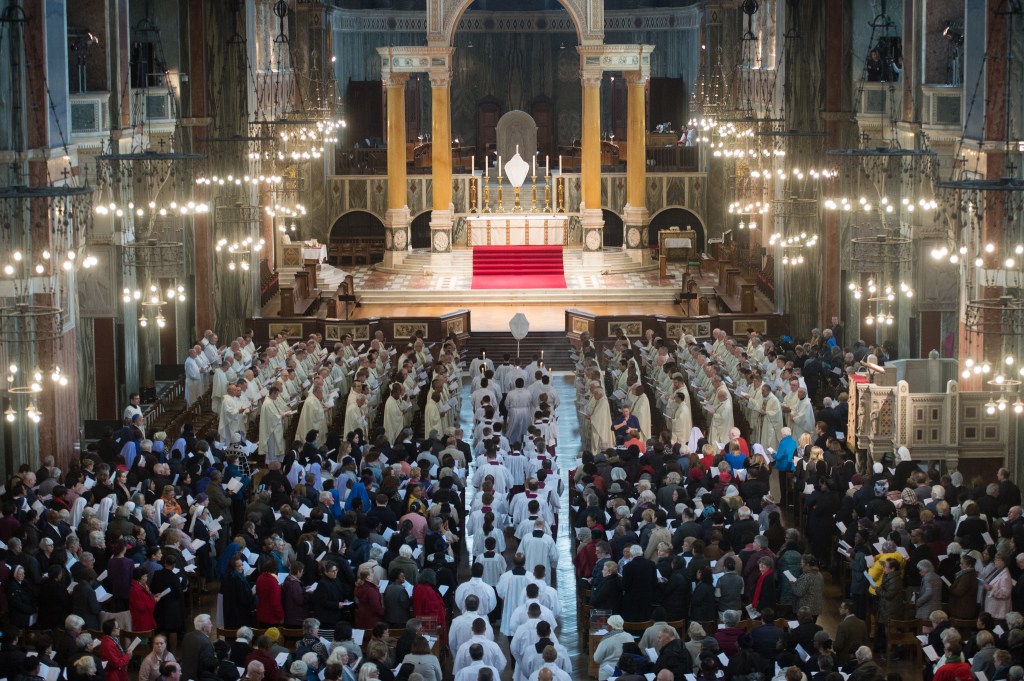
- Chrism Mass in Westminster Cathedral. Copyright: MARCIN MAZUR https://www.flickr.com/photos/catholicism/46898324454 (CC BY-NC-ND 2.0)
 common or garden theologian