Genesis ‘51’: Joseph manages the Covid 19 response.

God has covenanted with us through generations, starting with the special call of Abram’s family.

God worked through Joseph’s parents: Jacob, Rachel and Leah; as He has worked with Jacob and Esau; and with Isaac and Rebekah before them; as first of all with Abram and Sarai…

God’s sovereign working oversaw Joseph’s childhood, and Joseph has become a pattern to show us that God’s eternal purpose is as it always has been- to bring healing in and through our family relationships, to make us nation builders: kingdom builders. 

Now the Lord [had] said to Abram, “Go from your country and your kindred and your father’s house to the land that I will show you. 2 And I will make of you a great nation, and I will bless you and make your name great, so that you will be a blessing. 3 I will bless those who bless you, and him who dishonours you I will curse, and in you all the families of the earth shall be blessed.”

Gen 12: 1-3 ESV

Joseph, the favoured son of Jacob and Rachel, is marked out for blessing in his family both by extraordinary dreams and his father’s bias. As will later be repeated with Moses and then with Jesus, incarnation of God’s call and purpose with His human creatures is inescapably admixed with the realities of life in this world- God’s world and our human world, marred by the systemic rooted sinfulness at all levels: in self, in family and in society.

God’s vision and plan is bigger than we generally anticipate.  There appeared to be terminal breakdown in Joseph’s generation: his brothers narrowly avoided killing him. Instead, they sold him into slavery on a happenstance- so he was sent to oblivion in a distant and foreign land far from their cares, remembered only by his father Jacob in his grief.

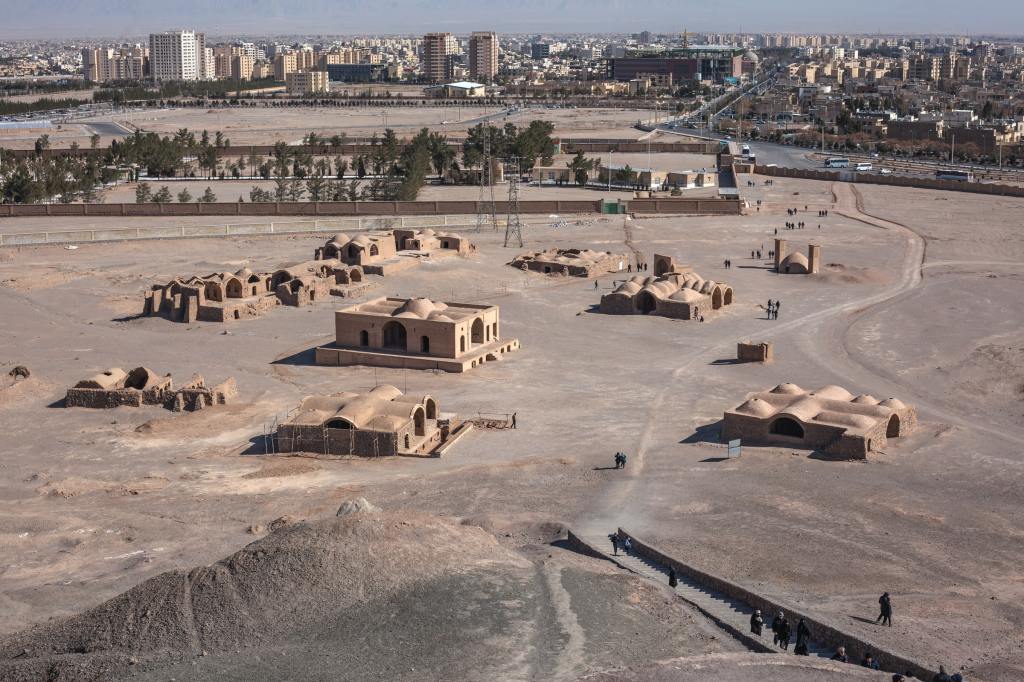
A camp of the Baharvand Lurs in the mountains of southwestern Iran photographed by Frank Hole in 1973 before the Iranian revolution.

Yet the prophetic life can be meaningful and empowered in the uninterrupted and uninhibited grace of YHWH!

We find that Joseph is still very much in God’s view; very much not forgotten as a person; very much not forgotten as the focus and embodiment of God’s dream-plan for nation formation and blessing of all the families of the earth.

We may ask, ‘What does ‘not forgotten as a person’ look like under God?’  It might include- this is probably going to be unwelcome news- being an obedient slave, yet not simply a slave who works to avoid punishment, but ‘as to the Lord’, exactly as Paul later put it in his letter to the Christians in Ephesus:

Bondservants,[a] obey your earthly masters[b] with fear and trembling, with a sincere heart, as you would Christ, 6 not by the way of eye-service, as people-pleasers, but as bondservants of Christ, doing the will of God from the heart, 7 rendering service with a good will as to the Lord and not to man, 8 knowing that whatever good anyone does, this he will receive back from the Lord, whether he is a bondservant or is free. 9 Masters, do the same to them, and stop your threatening, knowing that he who is both their Master[c] and yours is in heaven, and that there is no partiality with him.

Ephesians 6:5-9 (ESV)
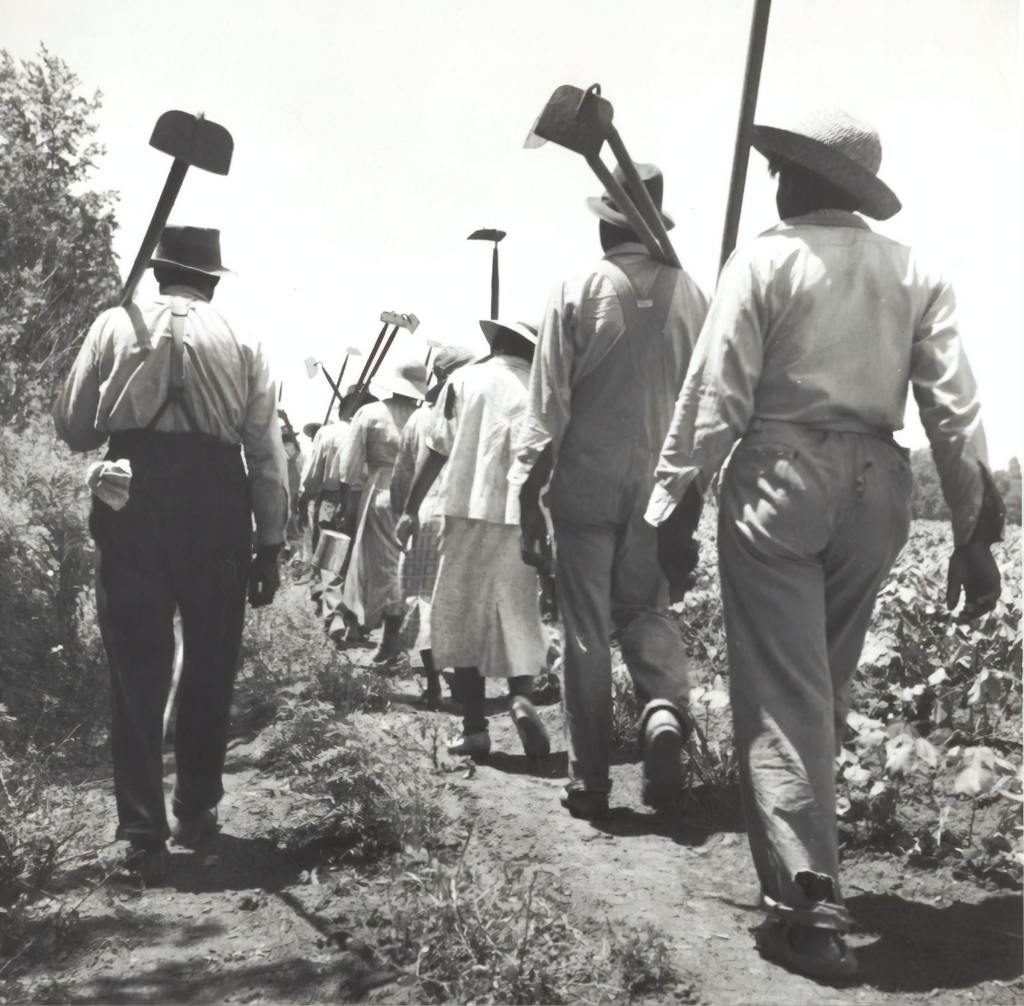
Mulatto ex-slave in her house near Greensboro, Alabama 1941 (above) These cotton hoers work from 6 a.m. to 7 p.m. for $1.00 near Clarksdale, Mississippi, June-July 1937. (left)

Joseph’s service continued faithfully when Potiphar was away on his business, because Joseph was living before the eye of YHWH. When the eye of his mistress fell on him, Joseph ran before the judgement of his Lord, and so his life was preserved even by his master on earth.  Joseph was thrown back into the dungeon, his life again spared even though accused of sexual sin in his master’s household.  The nature of human life before God is not merely in the business of survival- of crops and water, of herds and land, like the animals, but there is transcendence in the life of the heart, of dreams and motives, of ethos and the ways we live with each other, internally with ourselves. It matters how we think, and how we will choose to relate with one another, and there is freedom and agency in all this wonderful life we have been gifted with.  All the perils of Joseph’s life have, so far, been the products of the minds and culture of his community.

Joseph resisted the temptation to become cynical about the value of maintaining good character, and once again his faithfulness resulted in recognition and promotion to responsibility, even in the Egyptian jail.

Now Joseph discovers that not only is his personal morality a constant before God, wherever he finds himself geographically, but now he finds that God wants to speak through him into the minds, lives and destiny of those who do not yet know they can be the covenant people of the One God YHWH.  Though the word of God in Joseph’s mouth, listened to because of the quality of his life, and proved by the immediate results for the baker and cupbearer, yet God’s timing is still ‘not yet’ for Joseph.  Another two years must pass before Joseph discovers what God has been ‘working all things together for good’ for.

Much of the soil in the forest is a reservoir of untapped potential, a world of uncertain possibilities.  In addition to the accumulated water and mineral nutrients, there is a bank of dormant seeds, each concealed at various depths in the ground, apparently inactive, in a state of limbo between life and death. But one day- perhaps there has been a storm- a great tree falls and the soil is disturbed. Certain seeds are churned up to the surface after untold years, and light floods down to activate them.

The door of the jail is wrenched open, and the jailer brings word to Joseph. “Get washed and shaved! Pharaoh wants to see YOU.  That hapless cupbearer finally remembered what was hidden in his memory, and now your insight is called for!”
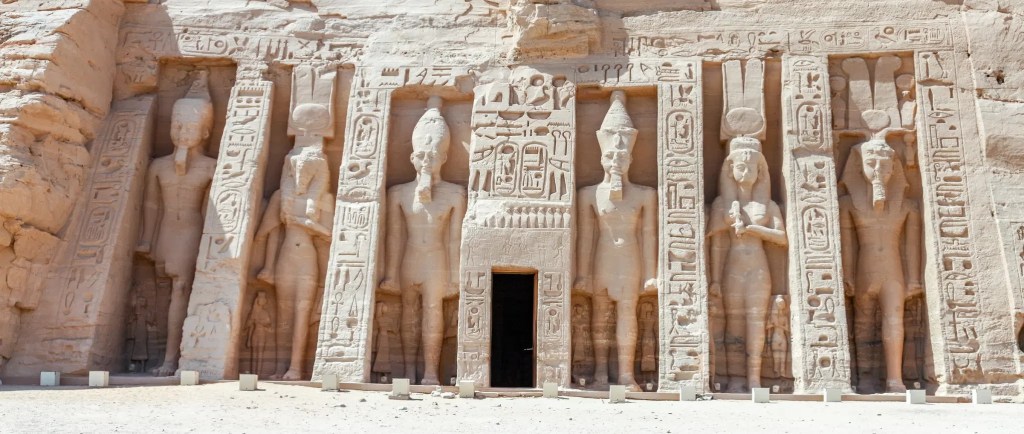
God has revealed possible futures to this ruler of men in this mighty land where Abram was once taught a lesson, both in morality and in the greater truth that YHWH God is in fact God of All (see Genesis 12:18). In an encounter that will resonate with Joseph, deeply probing and testing his heart attitude, Pharaoh has had two dreams, and his own ‘wise men’ and counsellors are judged inadequate for this crucial task of national leadership.  At this point, nothing has happened. Its all just been in Pharaoh’s head. God is God of gods and Lord of all! He is closer to us than breathing and He is certainly able to speak inside your head.  Pharaoh is now awake and perceives that the situation is one of life and death, on a scale much greater than his earlier concerns.  He gives up on appealing to his gods- they are not even mentioned. He gives up relying on his own insights- he is desperate, and his forgetful cupbearer now remembers that there is a man who has been tested and could just perhaps be of service. Joseph is Pharaoh’s last resort for searching out wisdom. A foreign slave in my jail, consigned to an inevitable death while an important raped woman awaits delayed justice. As Desmond Tutu describes, God’s justice wins. Oppressors must fail. Now Joseph stands before the ruler of the most advanced civilisation in the world.

‘Now is still the time of plenty. But life and death faces us all, as your baker and cupbearer discovered for themselves. You were once their judge, but now a greater than you is speaking to you, and this time of plenty will come to an end.  Then death will come for you all, but the true God, my God, YHWH God of my fathers and also God represented here in me is offering you a temporary rescue. We must all die to this life in the end, but it need not be now. You have seven years to prepare.’

Nothing has happened. Egypt has designed and self-created its own fruitfulness. God has gracefully and extraordinarily given a warning, but why should anything else change? Pharaoh does not make this mistake. He perceives that he has encountered the true God through God’s human servant, but does not make this response a religious one, but rather responds to its incarnational form and looks to the man that God has honed; the humble, obedient servant who is prepared to serve as a slave.  So he can promote Joseph if he wishes, and yet remain as a divine king himself, as was the habit of pharaohs. No matter- the ultimate reckoning will surely come.

There may be abundance now…

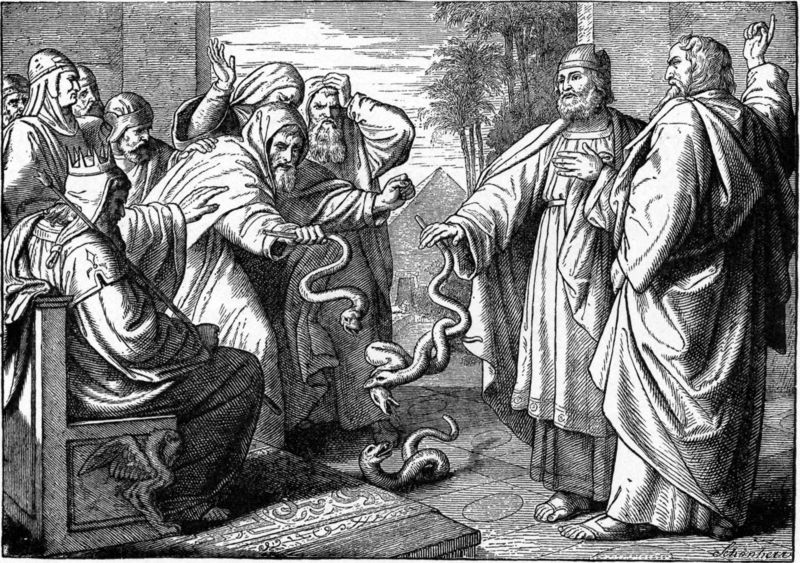
Then Joseph said to Pharaoh, “The dreams of Pharaoh are one; God has revealed to Pharaoh what he is about to do. 26The seven good cows are seven years, and the seven good ears are seven years; the dreams are one. 27The seven lean and ugly cows that came up after them are seven years, and the seven empty ears blighted by the east wind are also seven years of famine. 28It is as I told Pharaoh; God has shown to Pharaoh what he is about to do. 29There will come seven years of great plenty throughout all the land of Egypt, 30but after them there will arise seven years of famine, and all the plenty will be forgotten in the land of Egypt. The famine will consume the land, 31and the plenty will be unknown in the land by reason of the famine that will follow, for it will be very severe. 32And the doubling of Pharaoh’s dream means that the thing is fixed by God, and God will shortly bring it about. 33Now therefore let Pharaoh select a discerning and wise man, and set him over the land of Egypt. 34Let Pharaoh proceed to appoint overseers over the land and take one-fifth of the produce of the landb of Egypt during the seven plentiful years. 35And let them gather all the food of these good years that are coming and store up grain under the authority of Pharaoh for food in the cities, and let them keep it. 36That food shall be a reserve for the land against the seven years of famine that are to occur in the land of Egypt, so that the land may not perish through the famine.”

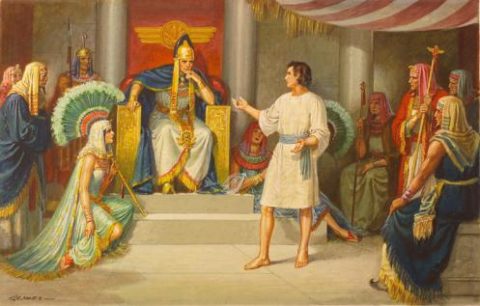
37This proposal pleased Pharaoh and all his servants.  38And Pharaoh said to his servants, “Can we find a man like this, in whom is the Spirit of God?”c 39Then Pharaoh said to Joseph, “Since God has shown you all this, there is none so discerning and wise as you are. 40You shall be over my house, and all my people shall order themselves as you command.d Only as regards the throne will I be greater than you.” 41And Pharaoh said to Joseph, “See, I have set you over all the land of Egypt.” 42Then Pharaoh took his signet ring from his hand and put it on Joseph’s hand, and clothed him in garments of fine linen and put a gold chain about his neck. 43And he made him ride in his second chariot. And they called out before him, “Bow the knee!”e Thus he set him over all the land of Egypt. 44Moreover, Pharaoh said to Joseph, “I am Pharaoh, and without your consent no one shall lift up hand or foot in all the land of Egypt.” 45And Pharaoh called Joseph’s name Zaphenath-paneah. And he gave him in marriage Asenath, the daughter of Potiphera priest of On. So Joseph went out over the land of Egypt.

46 Joseph was thirty years old when he entered the service of Pharaoh king of Egypt. And Joseph went out from the presence of Pharaoh and went through all the land of Egypt. 

Gen 41: 26- 46

And by the way, note the parallels with this episode in the book of Daniel.

Immediately the fingers of a human hand appeared and wrote on the plaster of the wall of the king’s palace, opposite the lampstand. And the king saw the hand as it wrote. 6Then the king’s colour changed, and his thoughts alarmed him; his limbs gave way, and his knees knocked together. 7The king called loudly to bring in the enchanters, the Chaldeans, and the astrologers. The king declaredb to the wise men of Babylon, “Whoever reads this writing, and shows me its interpretation, shall be clothed with purple and have a chain of gold around his neck and shall be the third ruler in the kingdom.” 8Then all the king’s wise men came in, but they could not read the writing or make known to the king the interpretation. 9Then King Belshazzar was greatly alarmed, and his colour changed, and his lords were perplexed.

10The queen,c because of the words of the king and his lords, came into the banqueting hall, and the queen declared, “O king, live forever! Let not your thoughts alarm you or your colour change. 11There is a man in your kingdom in whom is the spirit of the holy gods.d In the days of your father, light and understanding and wisdom like the wisdom of the gods were found in him, and King Nebuchadnezzar, your father—your father the king—made him chief of the magicians, enchanters, Chaldeans, and astrologers, 12because an excellent spirit, knowledge, and understanding to interpret dreams, explain riddles, and solve problems were found in this Daniel, whom the king named Belteshazzar. Now let Daniel be called, and he will show the interpretation.”

13Then Daniel was brought in before the king. The king answered and said to Daniel, “You are that Daniel, one of the exiles of Judah, whom the king my father brought from Judah. 14I have heard of you that the spirit of the godse is in you, and that light and understanding and excellent wisdom are found in you. 15Now the wise men, the enchanters, have been brought in before me to read this writing and make known to me its interpretation, but they could not show the interpretation of the matter. 16But I have heard that you can give interpretations and solve problems. Now if you can read the writing and make known to me its interpretation, you shall be clothed with purple and have a chain of gold around your neck and shall be the third ruler in the kingdom.”

17Then Daniel answered and said before the king, “Let your gifts be for yourself, and give your rewards to another. Nevertheless, I will read the writing to the king and make known to him the interpretation. 

Daniel 5:5- 17 ESV

So Joseph’s long season of management of the land of Egypt began in the time when normality and blessing continued unabated. The world God created is indeed God’s ‘good’ earth, and even under regular human husbandry there can be really good times in it. Yet as human beings under God we can see beyond this, because God made it that way. God built transcendence into God’s wonderful and ‘very good’ creation. God ceased from one activity- creating- and rested. God ‘took a break’ from this regular kind of action and did something that does not quite make sense from a here-and-now-thinking point of view. God made a holy day, and says to his covenant people that they should join him in this, as beings in his likeness should do the same sorts of things, in other words, be transcendent to the cosmos as we find it, because who and what we are is intended, by creation design, to go beyond what we see and touch.

Joseph has an insight into investing in the future. Perhaps not quite ‘store up for yourselves treasures in heaven that will not spoil’, but something prophetic of this. God has spoken to a foreign ruler and nation about a limited aspect of the future, and this must whet one’s appetite to consider what will lie beyond our mortality.  Exactly what the generation of the Egyptians at the time of Joseph made of that question we are not given insight into. Contemporary scholars known to me, such as Prof Colin Humphreys and others, are divided as to how realistic the Genesis 36-50 accounts are regarding Egyptian history, but the realist possibility is bolstered for Humphreys (personal communication) by the remains of very considerable grain stores from a plausibly appropriate period of history.

This is one of the sites where evidence can be found for the existence of granaries of very significant size, though not shown in this photograph. It is possible that the tomb under this stepped pyramid could itself have been a deep granary, which was then repurposed. There are also very considerable remains of arched brick roofed granaries similar to the Tunisian design pictured above at the temple complex of Luxor at Thebes. Some suggest direct correlation between these remains and the work of Joseph, for example, at josephandisraelinegypt.wordpress.com See my references for links to posts which find this possibility very persuasive. What I take from all the available evidence is that the ancient Egyptians had clearly learned a very considerable technology of storage for their harvest which was designed on an industrial- not merely a domestic- scale.


The Step Pyramid Complex of Djoser was built during the Third Dynasty (2800 BC) in what is now Saqqara.  Photograph by Dennis Jarvis, used with permission.
Pharaoh appoints Joseph as ‘Prime Minister’ of his nation, recognising the spirit of God in his life. He puts the entire nation’s food supply, prosperity and survival under Joseph’s management simply on the strength of his own persuaded convictions.

Joseph has been embraced as Manager-in-Chief of the nation by the Pharaoh and his servants. He is adopted into the Egyptian nation with a new name and family, inculcated into the priestly community by marriage and his family is recognised.  What a prophetic picture this is if the people of God serving their community as the outworking of their faithful devotion to God. Truly Joseph is ‘married to the land’!  He travels by personal private jet (!) to the far reaches of the Egyptian lands, in order to exercise watchful and directive management over the collection and storage of food and the building projects this must entail.  We can only speculate on the ramifications of the implementation of this visionary project.  The accomplishment of such a programme of public works must rival or even equal that of any of the other Wonders of the Ancient world; it is certainly equal in scale to what is thought the likely duration of construction of even the greatest of the pyramids of Egypt. And this was no vanity project, sustained out of the excess of production and spare time. This was motivated by the understanding that the very survival of the population as a whole was at stake. It was so successful at scale that when the neighbouring peoples came calling in the time of world famine, Pharaoh sent his desperate visitors to Joseph- there was enough and to spare!  So it was not simply the construction project that was placed in Joseph’s responsibility- it was the entire civil programme of management of the transportation, storage, cycling and release of food supplies, during the years of plenty and into the extended period of famine following. Joseph was deeply inculcated into the structure and function of Egyptian society at all levels, just as had been the case in principle in Potiphar’s household. Except this time, the mechanisms of society were at his direction, so there would be respectful compliance under Pharaoh’s delegated authority, shown by the transfer of ring, chain and chariot. 
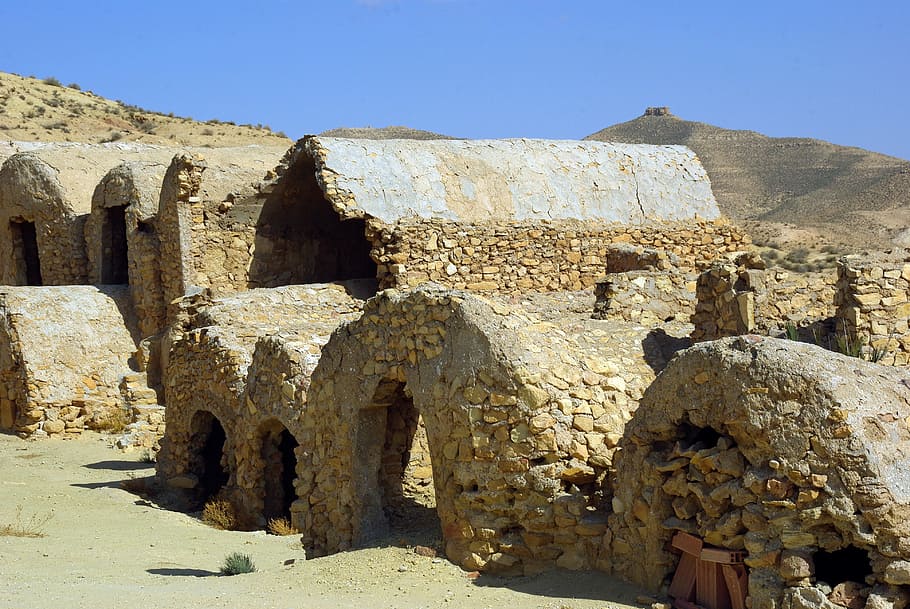
A design of grain storage found across north Africa, as well as in Egypt from the second millennium BC.

But this situation did not continue, after the visits, testing and reconciliation between Joseph and his brothers, as Genesis 47 describes:

Now there was no food in all the land, for the famine was very severe, so that the land of Egypt and the land of Canaan languished by reason of the famine. 14 And Joseph gathered up all the money that was found in the land of Egypt and in the land of Canaan, in exchange for the grain that they bought. And Joseph brought the money into Pharaoh’s house. 15 And when the money was all spent in the land of Egypt and in the land of Canaan, all the Egyptians came to Joseph and said, “Give us food. Why should we die before your eyes? For our money is gone.” 16 And Joseph answered, “Give your livestock, and I will give you food in exchange for your livestock, if your money is gone.” 17 So they brought their livestock to Joseph, and Joseph gave them food in exchange for the horses, the flocks, the herds, and the donkeys. He supplied them with food in exchange for all their livestock that year. 18 And when that year was ended, they came to him the following year and said to him, “We will not hide from my lord that our money is all spent. The herds of livestock are my lord’s. There is nothing left in the sight of my lord but our bodies and our land. 19 Why should we die before your eyes, both we and our land? Buy us and our land for food, and we with our land will be servants to Pharaoh. And give us seed that we may live and not die, and that the land may not be desolate.”

20 So Joseph bought all the land of Egypt for Pharaoh, for all the Egyptians sold their fields, because the famine was severe on them. The land became Pharaoh’s. 21 As for the people, he made servants of them[a] from one end of Egypt to the other. 22 Only the land of the priests he did not buy, for the priests had a fixed allowance from Pharaoh and lived on the allowance that Pharaoh gave them; therefore they did not sell their land.

23 Then Joseph said to the people, “Behold, I have this day bought you and your land for Pharaoh. Now here is seed for you, and you shall sow the land. 24 And at the harvests you shall give a fifth to Pharaoh, and four fifths shall be your own, as seed for the field and as food for yourselves and your households, and as food for your little ones.” 25 And they said, “You have saved our lives; may it please my lord, we will be servants to Pharaoh.” 26 So Joseph made it a statute concerning the land of Egypt, and it stands to this day, that Pharaoh should have the fifth; the land of the priests alone did not become Pharaoh’s.

Gen 47:13-26 ESV

Not only has Joseph been affirmed in his diagnosis for the Egyptian economy when he first interprets the double dream given by God, but now Joseph is given further authority over the whole country.  There are many subtleties in this passage, which must be carefully respected. However, I observe that the state of the nation is still in peril. The predicted famine has indeed occurred, as expected after the extended period of plenty, where much food was stored. The way the economy was made to work is indicated but perhaps not described in full. It is clear that the Egyptians have to buy the grain they need to eat from the store; Joseph directs that grain is sold back to the people from the national store, not only for food but also for sowing, as perhaps limited irrigation from the Nile made possible.  Joseph has told his brothers that two years of the famine have passed (Gen 45:6), and so perhaps we can surmise that in the following years, these were the arrangements:

Year 3   Selling grain for money*, which was collected in totality for Pharaoh

Year 4   Selling grain for all the livestock

Year 5   Selling grain for the people’s family land

Year 6  Selling grain for their service as ‘servants’
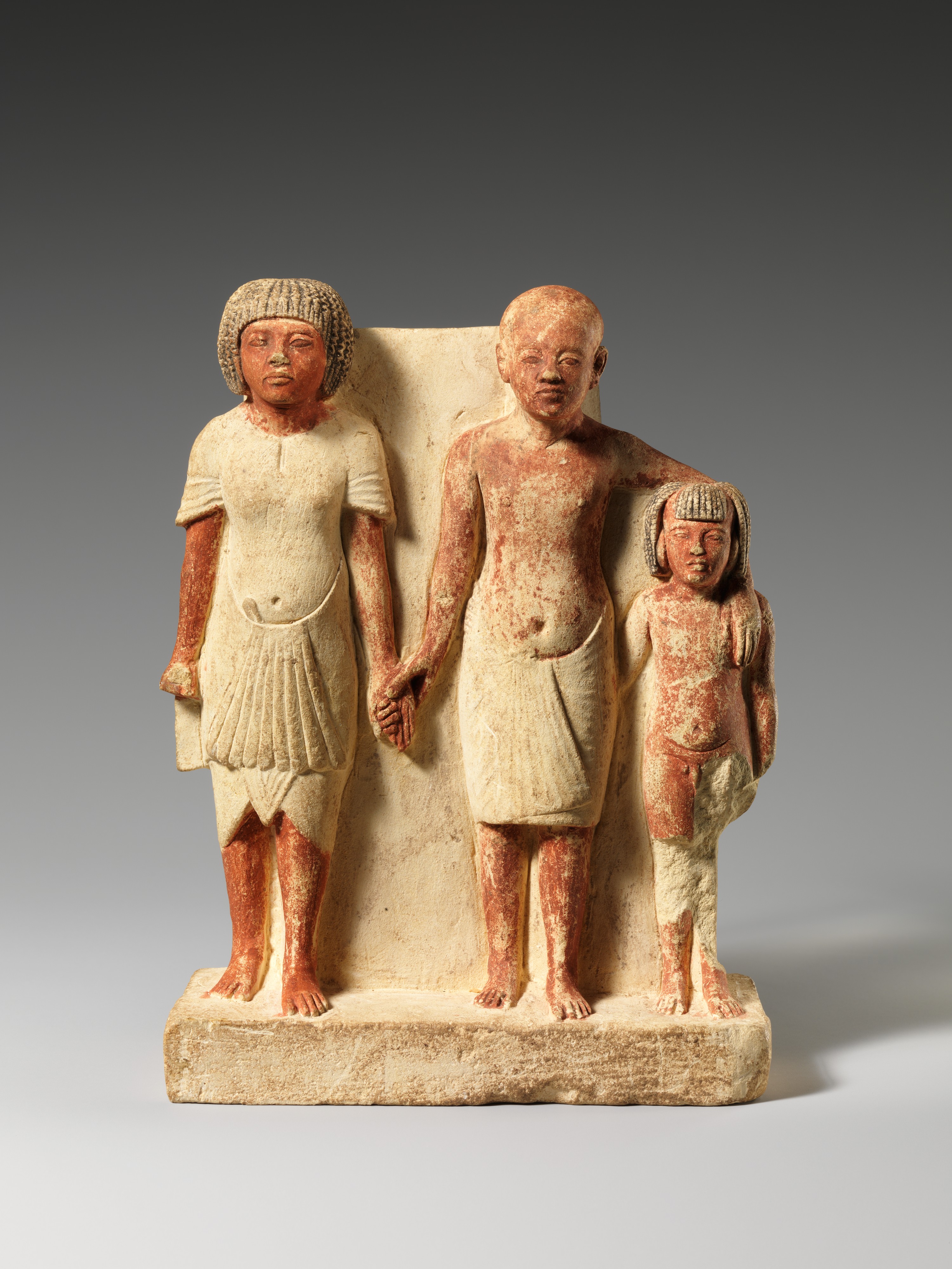
Statue of two men and a boy that served as a domestic icon. ca. 1353–1336 B.C. New Kingdom, Amarna Period. MET Museum.

Year 7  Finally, Joseph gives out grain allowances, as Pharaoh now owns everything.
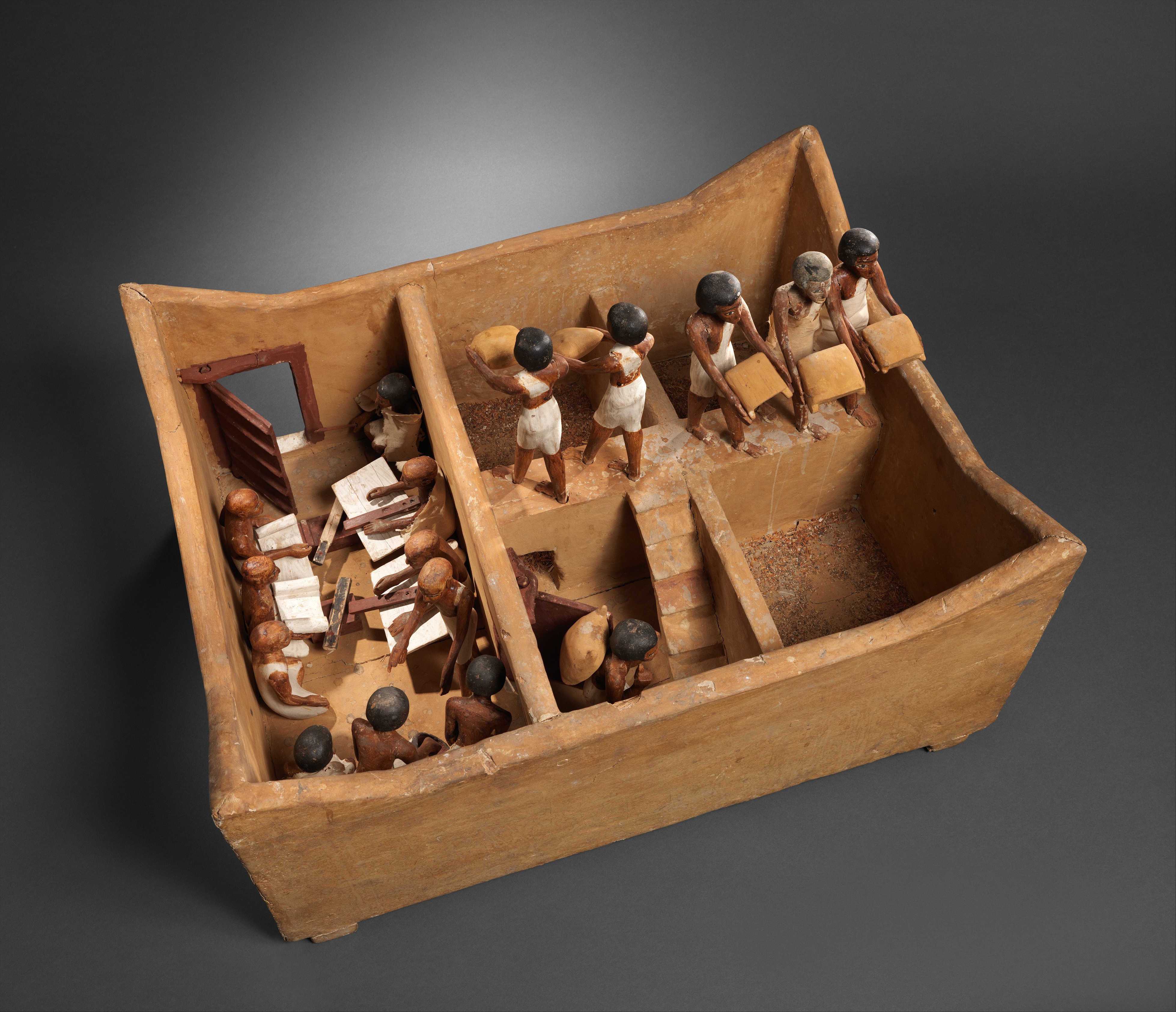
This model of a granary was discovered in a hidden chamber at the side of the passage leading into the rock cut tomb of the royal chief steward Meketre, who began his career under King Nebhepetre Mentuhotep II of Dynasty 11 and continued to serve successive kings into the early years of Dynasty 12. MET MUSEUM.

Thus the seven years of famine are completed.

Only the land of the priests and their supply is not taken into the ownership of Pharaoh, and perhaps this is a foreshadowing of the special rules that will later apply to the Levites in the Mosaic law to follow in the Torah account.

But in sum, we see that all human life is brought under the close ownership and control of the national ruler, which, it seems to me, is a figure for God, even though Pharaoh is a foreigner to the covenant God has made with Abraham. At the same time, in the way that the account shows the Egyptians speaking with Joseph, it is he who is being addressed almost as a divine figure, who sees all and has the life of all in his hands. Which is, of course, the way Pharaoh said it would be.  The principle of being a blessing to the nations has been put into effect even through the servant ministry of one man as a faithful manager of God’s House, in this case, demonstrated to our surprise in the ‘secular’, ‘foreign’, ‘alien’ context of another land, ruler and nation. Yet the true covenant God of Abraham, Isaac and Jacob is revealed there, and the story-journey of building the nation of God which will bless the whole world in all history will be continued.

Overworked, under-rested? Working and resting in the Kingdom of God.

In our present state of global upheaval and shutdown- an astonishing change to the usual way of things- social distancing, only some of us going to ‘essential’ work, travel suspension, reorganisation for business survival, layoffs and furlough and only partly adequate financial benefits; the vulnerable in self-isolation, queues at two meter spacing outside the supermarket, various signs of undiagnosed illness and a growing number of clear cases of Covid 19, some of which have led to  deaths in our own local circles, with the collective dread of more to come, I wonder what we can learn from the Joseph account in Genesis 36-50?

Well, I think it is plain that there are no easy answers in the Bible.   As believers we do now have peace with God, but there is so much more to that ‘peace’ than we may perceive in the common usage of the word.

Jesus says, (Jn 16:33) ‘I have said these things to you, that in me you may have peace. In the world you will have tribulation. But take heart; I have overcome the world.’

We recall;

Isaiah 48:22 There is no peace, said the LORD, to the wicked.  {but…}

Isaiah 26:3 You keep him in perfect peace whose mind is stayed on you, because he trusts in you.

Phil 4:7 And the peace of God, which surpasses all understanding, will guard your hearts and your minds in Christ Jesus.

If we are expecting to open our bibles and find a simplistic workshop in mindfulness and personal coping strategies, however, I think we will be sorely disappointed!

Let’s rehearse then the key points in Joseph’s life story, and this time, reflect on what sort of experience that was for him.

How wonderful would it be to awaken with the certain conviction that you have had a dream promising great spiritual significance? Well its just fine, right up to the point that, unable to hide your excitement in youthful enthusiasm, your brothers slap you down over the breakfast table, and your parents sit in silence. Then you have a second confirmatory dream, and the response is just the same as the first time, except that your father no longer holds his tongue and rebukes you as well.

How awkward are the following months and years, as your own suspect maturity is hardly enhanced by your own father’s favouritism in the face of your own brothers. Do I really want to wear this fancy coat? How nervous are we readers as we journey with Joseph on his ‘take care and report back’ mission, dispatched by his father to look out for his dear elder siblings.

So they throw the dreamer into the dry well- we don’t know if he is injured in body as well as mind by this, and he is left to call up for mercy from his brothers, who leave him in the night while they argue about his fate. It seems he is aware of their threats and pangs of conscience, but there is no sign of anyone bowing down to him any time soon.

Relieved of this father’s gift and sold for a prophetic bag of coins to nomadic traders, Joseph is forcibly removed from both his family and also the land of divine promise. Tied in line and led who knows where by harsh strangers who see only a commodity, or at best an object of pity. We are given no clue as to Joseph’s internal state of mind outside of his later actions; how quickly does he manage to regain his poise, and what is the part that prayer plays in his recovery? We could maintain that young Joseph was the model of piety and spiritual devotion, looking back from the heights of his later elevation, but such an attitude demeans both us and him. We should know that life is not like that.

What prayers do you pray in a slave market? What expectations do you have when the captain of Pharaoh’s guard commands your purchase? Perhaps you draw some small comfort from the status of your new master. But the way the Genesis puts it is, ‘The Lord was with Joseph.’ It is not Joseph’s character that is credited with the maintenance of his integrity- though he had that- but rather the weight of anointing on his simple and uncomplicated service. Yet it has an uncommon impact on Potiphar, and Joseph is promoted to an unexpectedly creative level of service in the household. Things are beginning to look less miserable as Joseph is completely trusted in his master’s absence.

The is nothing more attractive than innocent virtue, and now Joseph is tested by the wayward Mrs Potiphar. Joseph’s principled moral lecture falls on lustful ears, and he is presumably captured running from an impossible situation. Where is God’s blessing now? As is so often the case for the weak who are caught in the legal processes directed by the powerful and influential in society, Joseph is consigned to jail and left to wonder what his master believes, and whether his God will rescue him this time. Is it easier to live or die in these circumstances? It can have been no picnic in jail in Egypt, under such suspicion. What would be the content of your morning devotions? This time, surely, Joseph’s dreams must die along with the dreamer. How can there be escape from this predicament?

Through service, it would seem. Joseph discovers that being busy being useful has the effect of taking one’s mind off the desperateness of the situation. Take one day at a time. And he discovers that God’s favour does follow him into the jail cells.

Once again Joseph is tested by the dreams of the cupbearer and baker. What hope and dread must be stirred in his own heart and mind as he pronounces doom over one and salvation to the other; and in the cupbearer he puts his own tiny hopes: ‘Remember me!’

But after the removal of these two prisoners- who knows if Joseph hears news of their fortunes at the time- all Joseph hears is silence. Nothing. Abandonment. Not even cellmates with dreams of their own destiny to interpret. And what would be the point anyway? What on earth is my God doing? Is it worth calling Him ‘my God’ any more? How many of us would pass this test for two whole years- and after all that he has been through? How long does my integrity stand the test of isolation and invisibility- an hour, a day, half a week- a week or perhaps two. Months or even years? Truly?

Pharaoh wants to see me- to ask MY advice? At least by this time we would imagine that Joseph is past caring.  Is he confident in the gift of His real Master’s anointing? Is he certain that his life really is as safe and blessed as it required because God truly knows his conscience and tested integrity? What is the worst that can happen to me now? Joseph has walked through the valley of shadow so many times now- he’s got a season ticket with no option of a refund.

So Joseph speaks directly to the Pharaoh who has summoned him with respect, and yet as an equal, for Joseph is a man who knows that his life hangs in the balance of God’s scales, a much more serious prospect than the chief guard’s revengeful sword or even Pharaoh’s disdain for a dirty foreign upstart slave.

Only at this point does Joseph finally receive vindication before God and men- his true stature is at last recognised. And with the ring and chain of gold comes the most pressing responsibility. God has revealed what is going to happen in the fullness of time, but is going to do absolutely nothing about it. The great famine is certainly going to come, and will stay, on and on, mercilessly. Only the human designed and implemented plan will now stand guard between life and death for however many thousands or millions of people. There is no explicit blessing by God of this phase of the story, which declines into desperation as Egypt is brought through the full test. Yet Joseph sustains his efforts; who can say how much of a burden this was? The emotional charge in the relationships with the people toward the conclusion suggest this was no walk in the park. God has placed His very own reputation on the line in entrusting Joseph with this task of management. Who is to know how long the patience and confidence of the Egyptians will last?

I add that in July 2020 it is now becoming more plain to all that just as for Joseph, having a plan- even a good plan- for dealing with the initial phase of our pandemic, the longer term consequences are progressively more and more serious. It is not simply single aspects of our society and economy that are challenged, but the whole complex of interrelated elements. Will we be able to maintain a mindset that thinks holistically and at the global scale, or will we fall back into petty self interest and national independence? Joseph nurtured the dreams of God that set a standard for us.

Only at the very end do we hear the simple judgement – not from Pharaoh’s lips, who is sidelined at this conclusion- but from the people, who quietly pronounce their collective gratitude: ‘You have saved our lives.’

We are not to worry about tomorrow- what we will eat or wear. Our daily bread is a proper concern. Yet God uses Joseph to provide peaceful navigation into a good future for the most prosperous nation to which others came in their collective distress.

So let us consider in the test we face, where the health of millions is now at stake, what manner of integrity and faithfulness, what quality of attitude and prayer will actually be required of us. By all means let us open our Bibles for inspiration and example, and expect that God wants to anoint and empower the collective actions of His people in the interest of all, whether our neighbours understand the language of our faith or not. But let’s not be glib about the profound challenge we will face in spirit in every respect if we expect to truly speak God’s word into being on His behalf. If we lean steadfastly into God, He may bestow onto us the same blessing that Joseph enjoyed:

The LORD lift up his countenance on you, and give you peace.

Numbers 6:26

Stephen Thompson 3rd April and 29th July 2020 ©

POSTSCRIPT 05 07 21. There is nothing new under the sun. Or, perhaps better, God has been looking for co-creators for as long as God has been creating, and the LORD God does nothing without revealing His secret to His servants the prophets. (Amos 3:7ESV) I discover today that the thesis of this article is not at all new. But who has been listening to God’s invitation to partnership?

The Genesis Strategy: Climate and global Survival, by Schneider Stephen H..  Plenum Press, New York,  1976, 419 p., illus., $14.95 (75-40321).John E. Oliver BioScience, Volume 27, Issue 2, February 1977, Page 128, https://doi.org/10.2307/1297611Published: 01 February 1977

The spirit and power of Elijah in 2020

What can any one person do in the face of such a global challenge? What use can the faithful Christian hope to be, beyond the simple duties of looking out for one’s immediate neighbours?  It is certainly true that exercising individual responsibility is a serious duty and can set a significant example in behaviour for the local community.  Submission to the authorities for the health and well-being of all ought to go without much saying. However, the life of Elijah should teach us that God in fact intends us to have a much more profound impact in God’s world than we might imagine.   

Dedication to the Jung family, in memory of Lucy Jung.

13Is anyone among you suffering? Let him pray. Is anyone cheerful? Let him sing praise. 14Is anyone among you sick? Let him call for the elders of the church, and let them pray over him, anointing him with oil in the name of the Lord. 15And the prayer of faith will save the one who is sick, and the Lord will raise him up. And if he has committed sins, he will be forgiven. 16Therefore, confess your sins to one another and pray for one another, that you may be healed. The prayer of a righteous person has great power as it is working.b 17Elijah was a man with a nature like ours, and he prayed fervently that it might not rain, and for three years and six months it did not rain on the earth. 18Then he prayed again, and heaven gave rain, and the earth bore its fruit.

James 5:13-18 ESV

God’s world is the good earth on which we have been blessed with God’s gift of life.  Throughout human history there has been a measure of suffering, and none of us are isolated from pain. And there is also joy in life, in our time under the sun that bathes us all.  All of this can and indeed should be the cause and ground of prayer and praise, if we are listening to God’s Word and Spirit.  God created the world in freedom, and that world presently has illness in it.  This is how it is at the moment, though the New Day is coming when there will be ‘a loud voice from the throne saying, “Behold, the dwelling placea of God is with man. He will dwell with them, and they will be his people,b and God himself will be with them as their God.c 4He will wipe away every tear from their eyes, and death shall be no more, neither shall there be mourning, nor crying, nor pain any more, for the former things have passed away.”’  In the meantime, we are called and charged to wait and listen with Jesus.  When news of Lazarus’ illness came to Jesus from Martha and Mary, Jesus did not go up to Bethany immediately. (John 11:4)  Just as for Elijah, the circumstances of nature and the features of the cycles of life were not the ultimate things which dictated Jesus’ words and actions. In prayer and in fellowship with Father God we too can discover that sickness and health, life and death, even the circumstances of nature can all be brought to the feet of Jesus.  There will be seasons and weather, new life and passing on, pain and illness; the gifts of healing and resurrection are also available in the here and now of God. The natural powers and cycles are the creation of God, and yet are subject to God’s sovereign decree that though we are creatures with a common nature, the simple prayer of those brought into the righteousness of Christ can hear Christ and bring God’s overruling will of love and eternal soundness into our now.  The oil of joy is a sign that God’s healing power will have its victory over the sickness of each and every individual – if we will come to Jesus in faith with them. 

Elijah Predicts a Drought

1Now Elijah the Tishbite, of Tishbea in Gilead, said to Ahab, “As the LORD, the God of Israel, lives, before whom I stand, there shall be neither dew nor rain these years, except by my word.” 2And the word of the LORD came to him: 3“Depart from here and turn eastward and hide yourself by the brook Cherith, which is east of the Jordan. 4You shall drink from the brook, and I have commanded the ravens to feed you there.” 5So he went and did according to the word of the LORD. He went and lived by the brook Cherith that is east of the Jordan. 6And the ravens brought him bread and meat in the morning, and bread and meat in the evening, and he drank from the brook. 7And after a while the brook dried up, because there was no rain in the land.

1 Kings 17: 1-7

The ultimate order of God’s world is revealed to us in these lines. The Word of God will certainly come to leaders, even to unjust oppressors, and God will preserve his servants’ lives as He wills. We His servants can readily be sent into isolation, far from houses and storehouses, and the natural order of things can be reordered at God’s command. We are comfortable with the theological truth that God feeds the ‘birds of the air’, but at the time of national crisis when Israel was oppressed by the wicked couple Ahab and Jezebel, and the land was filled with the ongoing consequences of their godless leadership, God sends his son Elijah into a wilderness where he drinks from a stream and birds’ behaviour is reordered to bring a full diet to the man of God- two meals a day!  Eventually, the regular order of things emerges again in God’s providence, and Elijah’s journey with the Lord His God moves on to the next chapter. For while Elijah is preserved in personal safety, the peoples at large are in great and growing suffering, and the calling of God is on us for them.  In God’s will there is His perfect timing for us, and God is also looking to and fro in His earth to bring His best timing to all things.

The Widow of Zarephath

8Then the word of the LORD came to him, 9“Arise, go to Zarephath, which belongs to Sidon, and dwell there. Behold, I have commanded a widow there to feed you.” 10So he arose and went to Zarephath. And when he came to the gate of the city, behold, a widow was there gathering sticks. And he called to her and said, “Bring me a little water in a vessel, that I may drink.” 11And as she was going to bring it, he called to her and said, “Bring me a morsel of bread in your hand.” 12And she said, “As the LORD your God lives, I have nothing baked, only a handful of flour in a jar and a little oil in a jug. And now I am gathering a couple of sticks that I may go in and prepare it for myself and my son, that we may eat it and die.”

1 Kings 17: 8- 12
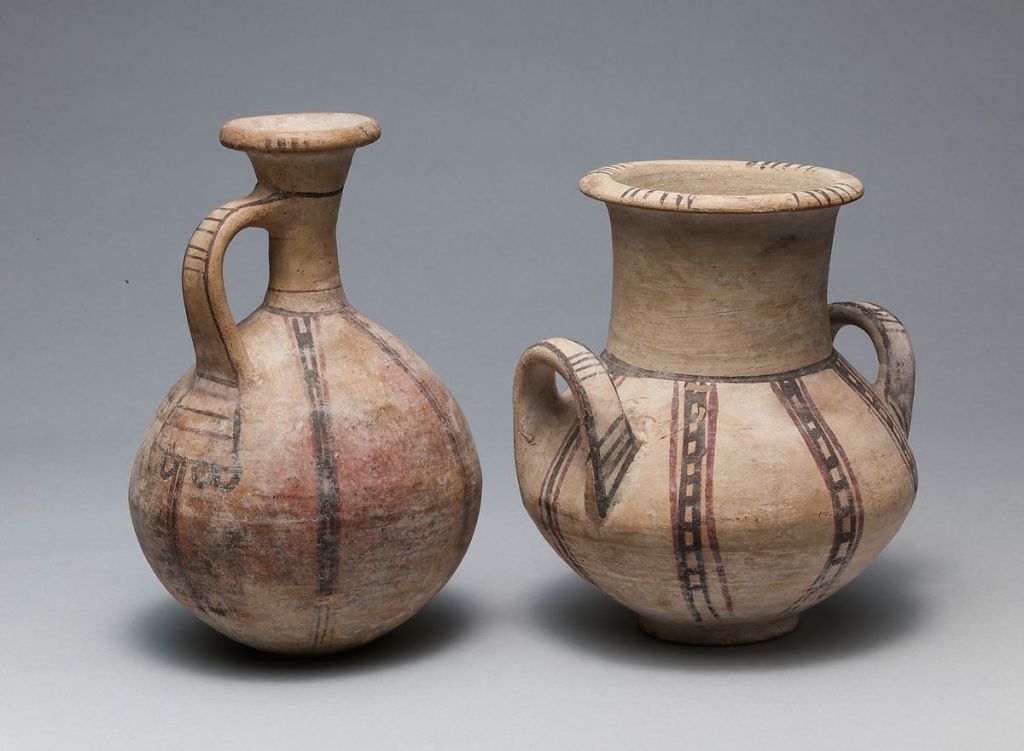
Single and Two-handled Jars; Marl clay, Egypt. Second Intermediate period. ca 1550-1458 BC

There are consequences in this life for the decisions made by nations and their leaders, and some consequences spill over into the communities beyond our own. And then again some things just happen in God’s world.  Elijah is now called to the foreigner in Zarephath: “Arise, Go!” God shows Elijah that he in fact has new neighbours. Elijah is a man like us, with a nature like ours. It’s a new day, and in every new day we are hungry and thirsty.  ‘Give us this day our daily bread.’  The prayer teaches us to say ‘our’ because we all need supplies and food, and if we consciously put our hands out together, we will see that our neighbour receives a fair share, as well as us. How much do we need? A daily portion- just enough. In this way the riches of our world are neither hoarded nor consumed in excess.  Though the widow in plainly suffering in lack, Elijah can be bold enough to ask for a little water and a morsel of bread.  Another day Jesus will ask a foreign woman for a drink from a well, because she has the bucket to draw up water. The widow discovers that Elijah is a man of God, but not a God she knows. “The ‘Lord your God lives’, you claim, but that life is no longer for me”, she points out. In saying this, she accuses God of unjust treatment!  She can only confess death over herself and her son. How will the prophet of God respond to her and to her immediate challenge to ‘his’ God? What truth will he walk in; what Word will he prophesy?  Will God send His ravens now?  The widow is now beyond fear, she is resigning to death as she looks the ‘truth’ of her circumstances in the face. 

13And Elijah said to her, “Do not fear; go and do as you have said. But first make me a little cake of it and bring it to me, and afterward make something for yourself and your son. 14For thus says the LORD, the God of Israel, ‘The jar of flour shall not be spent, and the jug of oil shall not be empty, until the day that the LORD sends rain upon the earth.’” 15And she went and did as Elijah said. And she and he and her household ate for many days. 16The jar of flour was not spent, neither did the jug of oil become empty, according to the word of the LORD that he spoke by Elijah.

1 Kings 17: 13-16
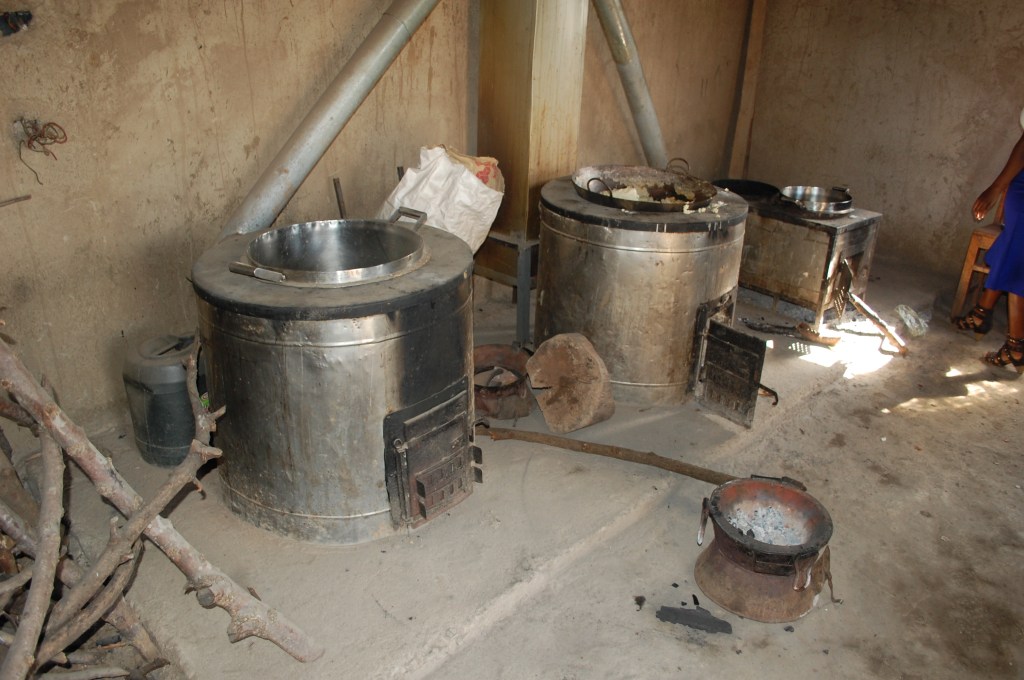
A young woman making chapattis from flour and oil over a three stone fire.

Through the newly creative Word of the faithful righteous-walking child of God, the existing order of God’s world is brought under the sovereign feet of the Lord of All- Who is not ‘merely’ the God of Israel, but the God of the whole world and all the peoples in it, including even this widow in Zarephath, who thinks that the God of Elijah does not know her name.  We are never told what her name is, but it is not always necessary to know the name of our needy neighbour. Just as in the days of Genesis, God uses his little and singular servant to learn faithfully, responsibly and humbly how to bring God’s provision in the midst of the most challenging circumstances. Joseph was called from prison to become the second in the land and the master of grain stores to feed an entire nation though a great famine- and the neighbours of Egypt came to be fed also- even Joseph’s brothers. Elijah too enjoys God’s supernatural supply in the kitchen of the despairing widow- and her whole household is also fed ‘for many days.’ What a wonderful conclusion this is. The surviving community is preserved and surely Elijah sees that God is glorified though his faithful partnership with His God, Whom he has learned to walk with through great trials. But just when all seems well, the page turns and the next chapter of Elijah’s journey begins.

Elijah Raises the Widow’s Son

17After this the son of the woman, the mistress of the house, became ill. And his illness was so severe that there was no breath left in him. 18And she said to Elijah, “What have you against me, O man of God? You have come to me to bring my sin to remembrance and to cause the death of my son!” 19And he said to her, “Give me your son.” And he took him from her arms and carried him up into the upper chamber where he lodged, and laid him on his own bed. 20And he cried to the LORD, “O LORD my God, have you brought calamity even upon the widow with whom I sojourn, by killing her son?” 21Then he stretched himself upon the child three times and cried to the LORD, “O LORD my God, let this child’s lifeb come into him again.” 22And the LORD listened to the voice of Elijah. And the life of the child came into him again, and he revived. 23And Elijah took the child and brought him down from the upper chamber into the house and delivered him to his mother. And Elijah said, “See, your son lives.” 24And the woman said to Elijah, “Now I know that you are a man of God, and that the word of the LORD in your mouth is truth.”

1 Kings 17: 17-24

Elijah hears the accusation of the woman, who it seems now credits him with things that we would suppose only God can do- bring remembrance of sin to her conscience and cause death merely by his physical presence.  What is the reason for the death of the boy? Presumably not a lack of food. Some mystery illness then, it would seem, that affects some family members, but not others.  And now the widow’s last hope is finally gone, and she only has grief to look forward to. Yet just as in John 11, the words of scripture are subtle.  ‘There was no breath left in him,’ we are told.  This dear widow thinks this end is death – she pronounces it to the prophet of God. But what will he say? And what will he do- with his extraordinary powers?  Elijah’s response is practised: ‘And’ means ‘immediately’- He seeks the permission of the mistress of the house: ‘Give me your son,’ which is to say, not, ‘Give me the body.’  She agrees to pass over her son to the man of God, and in what would seem to most people to be the time after death, Elijah carries the boy to the upper room where he does persistent and consistent and faithful prayer business with his God.  Elijah is not coy with his covenant God- he accuses God directly for this personal calamity and death.  Yet Elijah does not settle for the situation as it appears. He asks God his Question, and as Yahweh God once came to Abraham to seek the counsel of his friend regarding the judgement of Sodom with questions, so Elijah entreats his God even for an overruling of the regular order of things- under God’s greater sovereign will.  What is possible in the New Creation will of God, in partnership with his praying servant? What will we learn to be bold enough to seek God for?  For Elijah’s God listened to Abraham and also to Elijah: know that our God and Lord Jesus Christ also wishes to listen to us, as James 5:16 emphasises. 

“The prayer of a righteous person has great power as it is working.b 17Elijah was a man with a nature like ours, and he prayed fervently that it might not rain, and for three years and six months it did not rain on the earth. 18Then he prayed again, and heaven gave rain, and the earth bore its fruit.”

So what seems to be the end for the widow’s hope turns out not to be the end after all, and we are gifted with the realisation that there is an order in God’s world that is beyond the laws of weather, natural life or disease, and that is the demonstrated powerful effectiveness of the Word of the Living God in the mouths of His partners and praying servants.

Stephen Thompson 22 March 2020 (c) 2020

The LORD, Sarah and Abraham: A study in Encounter.

Then the men set out from there, and they looked down toward Sodom. And Abraham went with them to set them on their way. 17 The Lord said, “Shall I hide from Abraham what I am about to do, 18 seeing that Abraham shall surely become a great and mighty nation, and all the nations of the earth shall be blessed in him? 19 For I have chosen him, that he may command his children and his household after him to keep the way of the Lord by doing righteousness and justice, so that the Lord may bring to Abraham what he has promised him.” 20 Then the Lord said, “Because the outcry against Sodom and Gomorrah is great and their sin is very grave, 21 I will go down to see whether they have done altogether according to the outcry that has come to me. And if not, I will know.”

22 So the men turned from there and went toward Sodom, but Abraham still stood before the LordA23 Then Abraham drew near and said, “Will you indeed sweep away the righteous with the wicked? 24 Suppose there are fifty righteous within the city. Will you then sweep away the place and not spare it for the fifty righteous who are in it? 25 Far be it from you to do such a thing, to put the righteous to death with the wicked, so that the righteous fare as the wicked! Far be that from you! 26 And the Lord said, “If I find at Sodom fifty righteous in the city, I will spare the whole place for their sake.”

27 Abraham answered and said, “Behold, I have undertaken to speak to the Lord, I who am but dust and ashes. 28 Suppose five of the fifty righteous are lacking. Will you destroy the whole city for lack of five?” And he said, “I will not destroy it if I find forty-five there.” 29 Again he spoke to him and said, “Suppose forty are found there.” He answered, “For the sake of forty I will not do it.” 30 Then he said, “Oh let not the Lord be angry, and I will speak. Suppose thirty are found there.” He answered, “I will not do it, if I find thirty there.” 31 He said, “Behold, I have undertaken to speak to the Lord. Suppose twenty are found there.” He answered, “For the sake of twenty I will not destroy it.” 32 Then he said, “Oh let not the Lord be angry, and I will speak again but this once. Suppose ten are found there.” He answered, “For the sake of ten I will not destroy it.” 33 And the Lord went his way, when he had finished speaking to Abraham, and Abraham returned to his placeB.

Genesis 18:16-33

Footnotes:

A Genesis 18:22 NIV Masoretic Text; an ancient Hebrew scribal tradition but the Lord remained standing before Abraham.

B NIV Abraham returned home.

A surprise is served to Abraham by the Lord’s visit to his family in Genesis 18.  One might think- and most do- that the Lord, in the theophany of the Three Visitors, has come to see Abraham personally. But this is not really the case. In contrast to Genesis 12, Sarah has become the focus of the Lord’s attention, rather than her husband. Even while the couple are minding the niceties of respectful social graces and habits, serving bread, or cakes, and freshly cooked beef, the Lord has come to ascertain, to assure and then to decree that their longed-for child of promise will in actual reality soon be conceived and delivered- by ‘this time next year’! Abraham was in the doorway to his tent when the Lord appeared, and he had hastened forth to honour his guests. But Sarah did not emerge; apparently she never does. What does this tell us about her mindset?  No matter. The LORD can see, and not just through the fabric walls of their tent. He hears even silent laughter, and there is no obstacle to God’s Word conceiving and bringing to fruition exactly what He intends in His people at the right time.

As the three ‘men’ set out from Abraham’s camp, we see another shift in focus. They are looking down, towards Sodom. Our gaze is engaged along with theirs. What might they be seeing as they look down from their elevated position?  And see that we are told that Abraham is accompanying his Three Visitors as they go off on their way from his camping place. The man is walking with his God in the cool of the day. This is the way towards Sodom, we are told, and the man of God is joining His Lord in His journey. We are expected to anticipate what will follow for Sodom. And then-God pauses!  God’s intervention in the intimate moment of reproduction in this singular aged couple, after a long period of barrenness, is now immediately followed by a long-delayed but now soon-to-arrive corporate judgement. Yet again- just as the Lord did not simply ‘zap’ Sarah’s womb from on high in some disrespectful- violent– intervention, so again we perceive that God is not simply going to act in His world unilaterally. Is it not His ‘God-given’ right to do so? Well of course it is. If anyone has the right to mete out judgement, it is God!  But this is not what happens.  It is quite extraordinary. As Abraham is walking along, our focus is concentrated yet further- the three figures become One.  And we, the listener-readers are addressed directly, drawn in further to a secret question in God’s being. Perhaps we discover that we too have set out on this journey with Abraham and his Visitors.  The Lord speaks to us, in our hearing, and apparently less directly to Abraham. ‘Shall I hide from Abraham what I AM about to do?’ The one thing you could guarantee about God’s thoughts is that they are concealed, private, secret to God; known only to Him. Not any more.  In this prophetic encounter, we see not only that the Lord God desires to partner with his son Abraham, but He also desires to partner with us- and this co-creation is even in judgement! In asking this question, we see God’s freedom to choose- not only to consider judgement but freedom to engage in a partnership with Abraham in a more intimate and relational way; to choose to open this freedom to us, to all of us. God’s thoughts and even God’s plans are secret- but they need not stay that way.  As the Three Visitors look down and towards Sodom, we are already seated with Him in heavenly places. This is training for reigning on the job. Not only is God ‘going down’ to see in detail, in intimacy, as He did in response to collective hubris at Babel, but we too are beckoned to accompany Him.  God says that Abraham, His son of promised and continuing blessing, is to command and do righteousness and justice. That is, Abraham is not merely to obey God’s righteous decrees, in the mode of the line by line law of Moses, but to command. To do. This is the language of grand agency, the language of Genesis 2:15; ‘to till and to watch over it’. This is how Abraham becomes father, our type and pattern.

How then does Abraham engage with God in this circumstance of impending judgement?  He does not wait for the Lord to arrive at the city; he does not listen patiently until God formulates his conclusion for judgement. No! Abraham anticipates God’s next move. He takes the initiative and finds that he is given the most generous and open hearing. And here the dynamic of the relationship between God and His creature is displayed in extraordinary detail and frankness.

“So the men turned from there.” Earlier we were told that Abraham’s divine visitor had ‘set out’ purposefully, His Eye looking ahead of Him. In the pause that followed, we are given an image of God falling into a reverie, in which the Three stand around, circling with one another, pacing back and forth as they mull over the possibilities for the future, considering, deliberating. Their journey is not continuing; the future is not set. God’s future is not determined.  Creation is not complete! Though the outcry against injustice, against Peace, has risen to the Lord’s ears, yet God is not content with the report from afar. He is open to the possibility that there may be more complexity than is visible from far away: I AM going to find out.  In this dialogue, God’s omniscience is not invoked or allowed to give the final word. What could the obstacle be? What does God allow to prevent his determination of the right course of action? Abraham!

Abraham still stood before the LORD!  Truly, in God’s world, mercy triumphs over judgement, [James 2:13] and this truth is also in Abraham. He stands in God’s Way by standing in God’s way. What nonsense is this? Does Abraham think- do we think- that he can stand opposed to God, somehow preventing Him from going on his journey? Yes, he does. [In his generation, Jacob will take this a step further, turning it into a full-on wrestle!] Is God incapable of moving around the will and presence of this created creature? He does not want to! As an alternative scribal tradition [the Masoretic text] preserves it, the LORD remained standing before Abraham.  We would not dare to make this up. God wants us to get in His way.

Have we been cheeky enough yet? How assertive can one be with God? “Then Abraham drew near…” The phrase is somehow incomplete, as though to say, ‘Then Abraham drew near to God,’ would be just too arrogant. So instead, we have ‘…Abraham drew near…’ which retains a slight reticence, an observation of due deference even while exercising respectful assertiveness.

And said

‘Will You indeed…?’  Abraham confronts his God in word, not merely in thought. He questions God’s will, God’s character, and God’s intent- His rationality, reason and morality.  ‘Sweep away the righteous with the wicked?’ Abraham questions God’s values. Are not the righteous worth more than the wicked? So the calculation is not one of arithmetic, is it? ‘Suppose there are…’ says Abraham, engaging God in direct ethical reasoning, and in no abstract theoretical sense. Abraham knows, as we do, that the LORD is in deadly earnest.

For what did it matter?  All of this?  Earlier that day, Abraham had been interrupted at the flap of his tent. He was OK.  Just looking down at the ground, whiling away the time. Nothing much was happening really. Sarah was inside, doing whatever. Decades before they had left their families in a distant land and come here, looking for a new life. There had been grand ideas of a call from God, but what did that matter now? Their lives had gone by, and they had prospered well enough. They had endured various thrills and spills in the journey. Made a few mistakes, but things had worked out. Turns out we couldn’t have our own kid, but hey ho, the Egyptian maidservant came in useful. Sarah was very pragmatic about it all really.  Is it really a problem that I’m Ishmael’s Dad, but Hagar is his Mum? He still counts. It’ll be ok. Once, it seemed that God really meant it about us having our own child. All that stuff about counting stars and sand, and having new names. Very romantic. Perhaps it was just too much wine.  We’re ok really.  Real life is much more complicated than dreams and visions, and we’ve had to get real. I’m not sure that I should have brought Lot with us, but he made his choice. Its tricky in the city. The neighbours are a bit rough, but he’s managing. His kids are going to get married soon. He will manage.

Abraham’s eye is caught by a distant movement.  There are three figures on the horizon, moving closer. The Visitors came walking out of the sun, certainly and surely across the desert. Abraham starts up and hurries toward them.  He is aware of his heart pounding in his chest.  This is real.

You have indeed walked a long road, and you should know that I accept you with all your faults and failings. I did not call you because you were perfect. I am not surprised by you. Now I have come to make good what I have promised. This time next year there will be new life. New life that seems to you to be even more impossible than ever before. New life is starting now! There’s going to be another baby- the right baby this time. No disappointments, no more barrenness. And no lies, no deception. I am giving you a Hope and a Future. This is not a wall poster, but the real thing. I AM your God and I AM making a great people from you two. That’s how it’s going to be, ‘Father of a Multitude!’

Now Abraham is shaken from his depressed thinking, and the scales have fallen from his eyes. He can see starlight and sunshine again, and can see the difference between the bright sky and the shade under the trees.  Let me see You on Your Way!  My Lord, where are you going now? Down to the plain, to the cities where Lot is, well, surviving. No, that’s right, all is not well there. It is a very wicked neighbourhood, and something should really be done about it.  When I was a younger man we had to rescue Lot from kidnappers. My guys chased them down and there was a grizzly fight, but we beat them off and brought Lot back home safely enough. Thanks for Your help with that!  I can’t do that sort of thing now though. You have to let people get on with their lives. I am more patient with people now, you know?

There’s no more time for that? What do you mean LORD? Time’s up?! You are going down there to sort it all out.  Oh, I see…  Well, no; hang on a minute LORD! What about all that hope and future stuff?  Are you sure this is… right?  Should this be the real End for them all?

So Abraham is roused in his faith, and I note something else that is extraordinary here. Abraham finds a way to argue with God- a remarkable transformation in attitude. But he does not mention Lot by name. He does not indulge in special pleading for his particular relative. That would be nepotism, and he knows God too well to imagine He would fall for that trickery. No names then. So he tries a different tack. Abraham puts himself in harms way, for the greater good.  He puts himself in the way, between the LORD God and the object of His impending judgement.  The bearer of God’s promise of blessing is a hair’s breadth from being dust and ashes, just like the two cities, and he knows it.  What is he doing? Perhaps Abraham is using his unexceptionality as his bargaining tool.  You have chosen to bless me though I am nothing special, he says, so I am pleading for them, whose special quality is… that they are not special.  If I am nothing special, and yet I can be the object of Your patience and blessing-made-good, what about them? Not the wicked ones, obviously, but the innocent, the righteous? Dear God, please do not cut short all these lives, though many most certainly deserve it. You have come to confirm your blessing on me as the soon-to-be-real Father of a Multitude, and the means of blessing all nations. Well, I am not prepared to wait. You say you will bring judgement now; I ask that I can be the means of blessing now. Spare them all for even one!

And so in this Encounter between the LORD God and Abraham, we see that the first father of Israel does ultimate business with God on behalf of all peoples, both in his lifetime and in lifetimes to come. He sets a pattern, as intercessor and priest, pleading for those he knows, for his own family, and for his wider community, and those who are strangers to him. Abraham shows us that every human creature of God is a star in the firmament of God’s creation, and each of us can follow in the footsteps of Father Abraham, pleading in action and in prayer on behalf of all our neighbours. This may all seem to be simply words, but words are the Way of our LORD, the God who flung stars into space by the power of His Word, and breathes life into us by His rhema Word. 

Death and life are in the power of the tongue,

and those who love it will eat its fruits.   [Prov 18:21]

————————————————————–

The experience of dwelling in this scripture episode is teaching me that we must reorder our priorities in deciding what we know: our epistemological principles. This matters in a ministry that is predicated on research, on engagement with relevant data and the extraction of valuable insights drawn from a plethora of information.

We do know from Genesis 11 who the family is that God has dealings with in Genesis 12, both on Abram’s side, and also Sarai’s, but we know nothing about Abram or Sarai other than a little of their cultural provenance. No features of Abram’s character are brought to our attention. Speculations are made by commentators and theologians about the cultural setting of the places in which Abram’s character was formed, but we are left without any particular impression of his quality as a man- he is unremarkable.  Yet the LORD YHWH calls him.  Thus commences the life journey of the man who our Jewish friends call Father Abraham, honoured by St Paul in his letter to the Romans many centuries later. 

So in this chapter, Genesis 18, we find ourselves many decades forward into the years of physical decline in this couple, after many episodes of journeying and mis-steps. Though the recipients of Yahweh’s Promise- not only being blessed but also to be blessing to many, to the nations, to the whole world- they remain reproductively barren.  Apparently, the fulfilment of The Promise is not to be through Ishmael. Fundamentally, it seems clear that God’s Word remains… just words. Humanly speaking, we should know that the time for fruitfulness from this couple has passed by.

Now pay attention. God’s words have been spoken, and they will not return to Him void- meaning undone in chaos. On this day, the Three Visitors come to their place, their present home, in the promised land.  There is greeting, and welcome; the offer of hospitality- some awkwardness in the rushing around, in the hasty words between husband and wife, and the fellowship meal is prepared. Still Sarah remains inside the tent. Does she know Who has come? Does Abraham know who it is he calls LORD? We do not know exactly when the truth dawns on them, but we know, as we are told at the beginning, ‘The LORD appeared to him by the oaks of Mamre’. The LORD has come looking for his children in His garden. And he has come to ask questions. This time it is not, ‘Where are you?’ but, ‘Where is Sarah your wife?’  The LORD knows where she is hiding, but he wants to hear it from her husband, who awaits watchfully under the tree by their dwelling. In response, the LORD announces that the blessing will finally come about, in flesh and blood terms. Sarah can hear, and now Sarah knows she is being examined. And the intimate information is now made public- not at the time, but to us, in history. In a very delicate and respectful way we are told that Sarah is past menopause and she no longer expects ‘pleasure’. What can this mean? You would need to be married to know how to interpret this little ‘tweet’ of information. There are at least two possibilities.

But now this much is sure.  The LORD knows those who are His. He knows all their circumstances- the state of their hearts and bodies, and he knows their faith. Most of all, God is with them, and later, He will return (21:1) and His Word will be made good in the birth of their son Isaac, and then their laughter will be full. But that is for another day.

Now the Visitors rise to leave, and make for the cities of Sodom and Gomorrah. Whatever surprises Abraham has still to process from this encounter, he now knows this: His Lord treasures his fellowship. The appearance of his Visitors was sudden; unannounced. But they do not disappear as mysteriously as they had appeared.  In their moving on, we are told that Abraham is going with his Visitors, to ‘set them on their way’.  In this intimacy, the Lord God now muses aloud. We are told in detail: much information has come to the Lord’s attention about the state of life in the communities of the two cities in the plain. As we would expect from any urban development, an abundance of data has poured forth, as an ‘outcry’ to the Lord. This is repeated; there is much crying out. But why exactly? What sense to make of this information? Reports of sin and its consequences are complex and tangled- there are intertwined webs and knots of effect and cause. Who is responsible? What judgements are appropriate? Surely there could not be just one simple solution- could there?

As I have already described, we see the most marvellous thing in Genesis 18:22-33. In this extended encounter- reported and recorded in a remarkably long dialogue by biblical standards- we are made privy to an unprecedented development in the partnership of Yahweh God and his called servant son.  Though I am but ‘dust and ashes,’ says Abraham- well, he soon will be, if this doesn’t go well!  A few moments ago he was a wrinkled old man and the humbled husband of a barren wife. Abraham has now become something else. This is what faith in encounter is supposed to do to us, isn’t it?  ‘Can these dry bones live? You alone know, Lord.’ This man of God now stands toe to toe with the LORD of All- he ‘draws near,’ we are told in 18:23. We should be embarrassed to catalogue what he does next.  A few moments ago, Abraham was nervously answering God’s questions. Now he is asking the questions- challenging God to His face. He is questioning God’s perspective. Have you done your sums right? Have you counted properly? Are you sure- Abraham remonstrates with God- that you haven’t MISSED ANYONE? Abraham questions God’s moral judgement. Have you correctly identified which ones are bad and which ones are good? He argues about principle; yes, he lectures God on morals and ethics. “Shall not the Judge of all the earth do what is just?” He reaches out to pull at the LORD’s heartstrings.  “Far be that from You!”

And then he bargains with God. I am an English person, so when I go shopping, I look for the prices on the shelf, and scout up and down the aisle, inspecting the range of produce and sizing up their relative value. Six packs and ‘Buy two, get one free’ offers. How do they compare? But my wife Shon is Hong Kong Chinese, so for her, the urge to barter is not very well concealed. Bartering requires a certain arrogance- to confront the stallholder and to make yourself their equal. ‘We can decide on the price together. It’s not just up to you’, says my wife. It’s not very English. This is exactly what Abraham does. ‘What is the price of your justice, God? No, sorry, that’s too high. Sell it to me for less.’ Down and down he goes; 50, 45, 40, 30; still lower! 20, 10; and each time, the LORD agrees. You’ve got to wonder why Abraham stops there.  I used to think-this was me trying to be clever- that since the difference between 50 and 45 is 5, that Abraham has already proved that God would agree to just 5. What I couldn’t make sense of is why he doesn’t get God down to one. Perhaps that would be just pushing his luck too far. After all, as much of Christian social media continues to tell me, sodomy is really an extra-serious sin, and the presence of five, or fewer, righteous people probably are not enough to offset the wrath of God against this wickedness. But if you read onto Genesis 19:27-29, it is specifically recorded that God remembered Abraham, and that as a result of their agreement Lot alone is numbered as the one rescued from the annihilation of the cities by fire and brimstone. And note that this one was prepared to hand over his own two virgin daughters to the Sodomites who had been hammering at the door to his house. So much for Lot’s righteousness being counted on God’s balance sheet.  In this arithmetic, Lot’s disobedient wife is discounted, as are the two daughters who later seduce their own father out of an understandable desire to preserve their bloodline.

‘How unsearchable are his judgments and how inscrutable his ways! For who has known the mind of the Lord, or who has been his counsellor?’ [Romans 11:33b-34 ESV]

The scripture does not allow us the hubris of even looking on while the man of God knocks God and His justice down to just one.  And then God does it anyway, because He wants to go down to one.  Now we know what Abraham could not dare to know.  God is not willing that any should perish. [2 Peter 3:9]

The LORD has His satisfaction. His son of promise has become a father who speaks up for the many; even those not part of his own community.  Abraham has no more questions, but that is not what we are told. The scripture says that God had finished speaking to Abraham. The whole conversation was in the LORD’s will, and presented to us as such.  Only now is God on His Way, while Abraham retires to his place, to await the morning when he will go out to see what the LORD will create with His Word which they agreed together.

What do we now know? I discover that what we know is less about God’s judgement- there must be judgement, in the end. God will not be mocked.  And with judgement there will be unexpected and spectacular mercy! But more that that: we know that Abraham and Sarah are known to God.  What they are is known to Him, and so is the fruit of His promise in and through them.  Now, from our present high vantage point, looking back through the lens of the Life and Word of Jesus Christ, back from the perspective of Paul, whose life and words were formed and transformed by being blessed in Abraham, we can begin to grasp- to really know– who and what Abraham and Sarah were. Such knowledge comes to use from beyond human sensitivity, beyond our powers of finding out. This knowledge is the collective knowing of the crowd of witnesses though all of God’s journey with His people through history. [Hebrews 12:1] It is the knowledge of those who overcome ‘by the blood of the Lamb and by the word of their testimony, for they loved not their lives even unto death.’ [Revelation 12:11 ESV] This testimony is won by those who are prepared to face the fact that they are dust and ashes even while they live; those who will draw near; who will undertake to speak with the LORD, Who stands before us. What else is life for? I know that this is what is remarkable.

Stephen Thompson 28 April 2020 © 2020

  • toa-heftiba-_K0sTUUHQDE-unsplash
  • daryn-stumbaugh-wPqukwVYINk-unsplash
  • cynthia-magana-mFPJXEQfb9M-unsplash
  • kilian-karger-WKZ1DqPcP_s-unsplash
  • juli-kosolapova-akngFMXNV4o-unsplash
  • gavin-spear-TXu4dwPh7dM-unsplash
  • timon-studler-2NTdLXI7gUI-unsplash
  • shoeib-abolhassani-me_m68BRX70-unsplash
  • father-and-child-holding-hands-3752427 pexels

Executive Summary 1

14th May 2020. I am doing something new.

God speaks about His creativity in day-sized chunks. While each day is a new day, we have to consider how today will be like yesterday, filled with the streamlined products of good habits, or how it will be creatively different, perhaps completing and fulfilling some prior life work, or preparing for the emergence of enriching novelty, after the pattern of Genesis 1.

This approach moves the focus of attention away from the category mistake analysis of the meaning of the Hebrew ‘yom’ (‘day’) towards the more fruitful application question, “What shall we co-create today?”

15th May 2020. Introducing myself as a ‘Common or Garden’ Theologian

The names we give to one another, to ourselves, and to roles, and the circumstances in which we meet and relate- our environments and contexts- all determine the bringing into being of who we are and what things can be. My varied experiences as a teacher demonstrate this. Past saints and witnesses are teachers whose being is described and manifest through the context of the Word; the revelation of God creates an enduring yet under-determined environment for us to meet them in God’s Spirit, such as Stephen in Acts 6 and 7. Even the Spirit-filled apostles did not fully understand what they were creating when they appointed the first deacons in the ekklesia. In striving in partnership with God to be good disciples and good theologians, we can all become well-adapted to our context, environment and be fully released under God’s anointing to be His Word in Every Season. The common people are the mass of people, and all potentially have a place in the complete Body- not merely elites or an exclusive class. To be a ‘common’ or ‘garden variety’ Christian theologian is to be perfectly suited to the time and place in which we live, and therefore to reproduce with fecundity and great fruitfulness. Tomorrow’s common people, like garden-fruitful varieties, thrive in every season because they are hardened through nurture in challenging seasons, familiar use, training through partnership and embedded habits that stand the tests of time. This hardening comes through adapting to the benign changes in our environment, as well as more aggressive assaults of the trials of life, including persecution.

Any and every minister in the Spirit is like a totipotent cell; while specialised, having the potential to express the life of God in any way required.

The significance of naming is thus explored; a thing or person is both what it was created as and what it is in the process of creation to become; being AND becoming. Through naming we are brought into contact with the past purposing and the present will to be; and also with the potential future beyond current realisation. Elsewhere I will explore the propensity for God to rename God’s people, in order to continue the process of creatio continua. There is a spectrum of co-creation to be elucidated, for example, in the spiritual activities of prophetic life and ministry.

21st May 2020. Unlocking potential. Gen 39-41

As a boy, Joseph’s dreams resonate with the progressive picture of completed functional relationships depicted on a cosmological scale in Genesis 1. The experience of broken family relationships bring him down to earth with a bump – not least due to his own ambiguous role as ‘dream teller’, and then into an unexpected exile that God does accompany him into, just as God gracefully accompanied Cain into his life world outside God’s garden in Gen 4.

Because of the continuing covenant Presence of YHWH with him personally, Joseph is blessed, and brought, even as a slave in a foreign household in a foreign and distant nation, into God’s ‘very good’, personally becoming the blessing of God in the ‘alien’ environment. This is still God’s good earth!

As Joseph was tested in relation to his words and deeds with his own parents and brothers, now he is tested again in relation to his master’s wife: he shows himself a covenant-keeping Hebrew man under Authority. The episode with Mrs Potiphar is backdropped by the marriage encounter of Genesis 2 and shaded by the grasping desire of the temptress, who acts like Eve in Genesis 3. However, Joseph’s response shows his inward heeding to God’s warning regarding what is forbidden.

Joseph’s unjust but surprising ‘lockdown’ is connected with out current circumstances and the testimony of Terry Waite. In these ways I claim that the Joseph account is, unexpectedly, a pattern for us. Waite’s experience shows that the ultimate constraints of a confined cell need not be seen as a complete obstacle to the child of God filling each day with good as co-creator. [The whole universe is mostly nothing, but God has set a transformative creation in process in one minuscule corner and this little seed is continuously nurtured through God’s watchfulness, though surrounded and immersed in the blackness.]

Following testing by the lustful Mrs Potiphar, Joseph is again tested in his apparent though limited responsibility in prison by the arrival of elite dreamers from the highest class of society. Joseph’s faithful and exceptional management is shown to function at the deepest levels of his character, as he represents God in whose image he is made and according to whose Word he speaks, completely without bitterness. He is, nevertheless, still honestly conscious of his own humanity and plight. And yet again, without explanation, Joseph is left abandoned, surviving to thrive, like a buried seed, for an unknown future day.

The engineering imagination of Henri Giffard is paralleled with the mental life cultured in solitary confinement by Terry Waite. The harnessing and control of potentially fatal forces is used as a parallel to the challenges to our mental and spiritual health in trials. Understanding of the ‘scientia of God’s gift of life’ is that it is nurtured by God’s Word within us- and we have to continually feed on it to receive this gift.

God does care about us and the principle of justice, but His larger purposes entail mysterious priorities. Joseph may have dreams, and Pharaoh’s servants may also hear from the true God, but God’s own dream, God’s greater dream is unveiled in God’s good timing, and may be revealed even to pagan rulers.

In God’s very good timing, the faithful servant will be released into the flow of breath of the wind of God’s Spirit, and we must be ready to go with that mysterious flow- nevertheless: UP into God’s greater opportunities which will require and demand BOTH our nurtured human and anointed spiritual qualities , if we let patience and faithfulness have their perfect work in us.

24th May 2020. Interpreting troubled times.

Like global society and our own experience, we are in troubled times in this pandemic; significantly, this is a mental test, and so Pharaoh awoke from his double dream. He rejects the opinions of his people and his management team because he is looking for deeper meaning and significance in his dreaming, not because the nation is yet in trouble. There is an active deposit of the image of co-creator within even him, a pro-active urge that trumps tradition and habit, a super-adaptive bent toward the Transcendent- a specific connection to the One covenant God Whom he does not yet know.

So Joseph is summoned in his readiness, and he brings God’s revelation perspective on society as a whole and the far future. Everyone is included in the concerns of the revelation, and everyone’s role is scoped out. Economy and community, farmers, managers and court; the present, the future, plenty and want, life and death. All is put into its place in this vision of non-exclusive co-creation. This everyone looks on the plan and on Joseph who conceives it with unexpected and unpredicted favour. This extends to the fact that the whole world is brought to Joseph’s table and the entire nation expresses gratitude when all challenges and trials have finally been resolved.

While born of revelation, Joseph’s interpretation is realistic and scientific, engaging with the nitty-gritty of farming and food storage, of person management and vital coordination of the division of labour. It is not a vision of religious hegemony but an evangelistic vision of blessing and invitation; after all, death will still come to all who are fed through the famine. Theology ought to bring an overarching view to life, and this account encompasses the full expression of life and talent, rather than being one that negates human work or faithful stewardship.

Such a theologically informed overview is the antidote to the division between the Two Cultures that is presently playing out again so tragically in this pandemic, where wise men are treated sceptically and too much attention is paid to the pagan gods, especially mammon and pride, and this sadly applies inside the church as well as among global leaders and communities around the world. The scientific and medical realities cannot be ignored, just because there has been a significant elapse of time since the lessons of hygiene and immunisation were learned in generations now mostly past. Wisdom is wisdom rather than simply knowledge because it should outlive fads, fashion and passing ideologies. Ignorant and immature leaders of weak character may sneer at wise counsel, yet wisdom remains within reach, through repentance and a humble willingness to learn.

The prophetic voice of the theologian who is alert to the revelation of God’s Word and the revealed reality-in-being of God’s world must be spoken to all parts of society, for power lies in every part, and so Truth must be spoken to Power in all parts. This truth speaking, true-life-living witness surely ought to come from the ekklesia as a whole, not from an elite, and not offered exclusively to any elite. The leaders who are in post only represent the body of people that put them there, after all- both in the world and in the church. God’s love for all the world is meant to come through us to the world known by science, and in which we do our business, though science itself does not have the capacity to know the love of God. That is in the gift of the people God has created to live and work on this earth, and this gift must be theologically taught so we are enlightened, empowered and fully understand our mandate to discharge it.

To put it as my manifesto: God wants us to create the future with Him. Right now, the nations are looking for Joseph-like image-of-God-like overseers. Who will they find? Will you get ready? For us as for Joseph the young dreamer: God’s creation is waiting for us.

29th May 2020. Obadiah, God’s secret leader in crisis. 1 Kings 18.

My thesis is that God wants our partnership as co-creators of His future, using our creativity in harmony with His creativity. That’s a bold job description. There are scriptural candidates popularly considered to be ‘great men of God’, but reflecting on Elijah and John the Baptist provides a more sober assessment of the boundaries of that category.

God’s co-creators should aspire to being God’s vessel(s) to impact society at even the highest levels and in the most challenging circumstances. However, we will certainly not be protected from the worst consequences that others face, whether ‘natural’ disasters or the oppression by the powerful.

Obadiah, the keeper of Ahab and Jezebel’s royal household, may seem to have been a competent ‘Mr Average’ but is painted by the text to be God’s co-creator of God’s Shalom community directly in the face of idolatrous oppression. He succeeds through a quietness which conceals considerable cunning and radical action. I imagine what the business and managerial implications for Obadiah’s leadership would have been, and couch them in modern terms which help relate his lessons for us in a pandemic, Brexit and general post-industrial economic development. Obadiah shows how to straddle the so-called ‘sacred-secular’ divide, doing his best to sustain the whole of the royal household of God’s nation, in the face of challenges on all fronts that would reasonably seem impossible to overcome.

Thus I consider the long term and daily challenge posed to a leader who finds themselves trapped in oppressive circumstances, especially those seeking to be faithful to God and continue working and leading with spiritual integrity in a hostile environment.

God sees his secret servant, and now Elijah is coming to confront Ahab: God has also determined that this showdown will include Obadiah having to ‘blow his cover’ to declare the justice of God:- obedience will require Obadiah to be prepared to die. Such may be the faith stance of God’s co-creating leaders.

In his human frailty, assailed by natural fears, Obadiah discovers that God – even incarnated in God’s ‘elite’ servants- will keep his life as He wills. Co-creation of justice is a joint enterprise to which God is committed, though we may well not see how this will be accomplished. In God’s timing, Elijah’s words and actions come into lockstep. So Obadiah’s integrity must also be expressed in public words, as it was in his secret scheming. God’s Word and Actions will also be seen to be One, just as they are in His co-creators. This is the mandate for co-creation and co-leadership!

This is the narrow prophetic road trodden by the first believers, by Bonhoeffer and the disciples in Nazi Germany, and today in China. We may not see God’s victory while we endure national and international crises today, but it will come in God’s Tomorrow.

9th June 2020. Creating community with concrete. 1 Kings 8

Sermon celebrating the opening of the new community building by Rahema Church, scheduled for 6-8th April 2019. (written on 17th Jan 2019)

Celebrating and examining the vision and motives for building a community meeting place after the vision of David and Solomon’s temple. Treasure should be invested, but with the right intent, to facilitate servant leadership, not self-glorification or denominational domination. Inspiring a better pattern of joint leadership by ekklesia and community to set a prophetic example to the religiosity common in Kenya and across Africa.

Connecting the vision for chimneys and cook stoves with the health implications of smoke, by which God drives out the priests and worshippers from His Temple! The kitchen at Rehema is developed at the same time as the community building, showing the connection of spiritual worship with practical lifestyle issues, impacting the complete health of the community and setting a holistic example.

Impart the new vision of co-creation of community after the Pentecost pattern, where the Spirit of God rested as flame without smoke on each and every one of the saints of God.

12th June 2020. Which comes first, the wine or the wineskin?

The Genesis 1 creation account breaks and rebuilds our understanding of God’s nature and creative action. God’s Speaking is ultimately creative, and the claim of Genesis is that God’s Voice-Word is the fundament of all creation and being, expressed through the priority of light as light over any specific natural source of light in this text. This is also the prelude to the Exodus creation of Israel- a community in becoming- the family people of God demonstrating the generational covenant of God, which begins with Abram and Sarai. [This People is (to be) YHWH’s light in YHWH’s world.] [The fact that Gen 1ff is a polemic refutation and corrective thesis is perhaps to be taken as a caution against alternative human rationalisations on the question of ‘how’ God did it.]

In Exodus, Moses is called, charged and mandated to become God’s creative mouthpiece; lead discipler of a not-yet nation and speaker into being of God’s not-yet but soon to be People. If the gift to humanity of the seven day cycle is the idealised framework presented in Genesis 1, then the ten principal deities of Egypt are the contingent and necessary context for Moses’ voicing of God’s will into being on God’s behalf- as the imager of God in human Word on God’s behalf, as mandated by God. This is a prophetic birthing creation of God’s Kingdom People for all time: the Father’s will, gestation and birth pangs mysteriously bring order over and above any opposition [such as the false worldview and ideology of Egypt]. Israel is finally brought to birth and freedom though the Red Sea baptism, delivered through the intertwined co-creating of Moses with YHWH God. Moses’ popular reputation is as the receiver and giver of God’s Torah Law; but this is preceded by the creative word of deliverance. Truly, Moses’ words in God’s Name to Egypt are words of judgement, but they are also fundamentally creative. What is more, these words that God is pleased to be spoken by us on God’s behalf are creative tools that manipulate the most fundamental elements of God’s cosmos; even with principalities and powers, as exemplified by the pantheon of Egypt, presided over and manifest through the person of Pharaoh and the cultural apparatus of the state of Egypt.

We have been misled, or lulled into a false sense of security, by the conceptuality of God’s sabbath rest on the seventh day, and the projected sense that whatever God has been doing- that God is doing since the creation week, is somehow of lesser significance than that of the initial creation. This is certainly a product of the position of the Young Earth Creationists, on which I speak from some significant experience. The initial creation is important, of course, but not that important, and the imbalance is exemplified by the anthropocentric concerns of salvation, local church and discipleship, and the narrowly constrained priorities of world evangelism. All of these things are important, but they have been elevated above the fundamental question of what we are here for. Is the earth and our current lives on it merely a cosmic waiting room, in which there is an advertising campaign for the main event which follows? Is this life really of no consequence for the hereafter, or is it a potentially distracting prelude in which whatever we make is likely destined for fire and destruction; is it really only the binary destiny of our souls that is at stake? And if we have been missing something, what is the nature of the relationship between our creativity and God’s ongoing creativity?

I ask again: Is the only significant creative act after the expulsion of the first couple from Eden’s Royal garden the resurrection of Christ? And the birth of His Church Corporate at Pentecost, in which my part is simply to serve the collective whole, and in which my most significant contribution could be to suffer persecution and death for the sake of the Name of Jesus, and thus to feature in the sacred scene in Revelation, where the martyrs call out to God for the consummation of all things from beneath the heavenly altar?

If the dying of the seed of Christ is a sowing of a dream into the ground- the best dream of God, then surely it should have much fruit- not just one fruit. ‘Many sons’, the scripture says. And all of these children of God have a voice, and God’s Voice can be heard through them all. What varieties of ‘calling things which are not as though they were’ might thus be heard in the far reaches of the realm of creation?

The profound claim of the Bible; its Word of creation, is that we continue in the mode of God to create one another through the words and lives that we create-speak. This is fundamental education-parenting. “It takes a village to raise a child,” and how much better if God’s Voice is listened for, facilitated, imitated and modelled in that Village, even on this Earth in this tiny corner of God’s cosmos. Such is the dream of Resurrection and New Creation- God’s very dream. This encompasses and exceeds evangelism and discipleship, small group life in local church and more besides.

Mark 2 and Matthew 9 show that we must take a double view on the co-creation of the New Life of God: it is both about the new life within us which we each receive from God, and also about us taking responsibility for the necessary context in which that life is held and grows. To put it technically, we are responsible to receive God’s freely bestowed ‘top-down’ influence, which is a partnership, and also to be responsible for our ‘bottom-up’ agency in shaping the environment in which everyone lives, at the community level, which is the Church AND its outworking influence into and with society at all levels, as far as possible.

If Mars is indeed OUTSIDE the Goldilocks zone, regarding physico-chemical criteria, perhaps it is yet properly INSIDE if those criteria are extended, bio-theologically, by the arrival of the imagers-of-God. Individual flesh becomes resurrection body (individual) AND collective Body of Christ! Married in this life- yet whose husband shall she be? As the angels… yet One. So why did God create this universe, as second prof asked me at induction. Hide and seek… found… and then…

————————————————————————————————————

Genesis 1: Exemplar narrative of God speaking into being, freely turning Divine Dream into reality of human becoming. Let there Be!

Genesis 37-50 Joseph, the pattern of co-creator made good through God’s blessing even on a willing child. Steady growth in character enables us to receive the grace of God in order to pass the tests that we would otherwise fail.

Exodus. Let my People Go! The co-creative speaking-into-Being of Moses, who will meet the Christ-Head of His New Body at the Transfiguration.

1 Kings 8 The nation of God and the children of God follow God’s instructions, timing and Way to bring God’s Presence back into God’s creation, prefiguring the life of the Body in the Spirit. God’s transforming and prophetic Presence is indeed Here With Us, not far off in some Platonic ideological utopia.

1 Kings 18 The prophets of God co-create the justice of God, prefiguring the complete surrender of the suffering servant, God made flesh, Incarnate, to carry the consequences of our iniquities. The prophets co-create this salvation in a significant measure as God directs. Elijah is the prophet of God’s justice through suffering, who will meet the Christ-Head of His New Body at the Transfiguration.

[The various episodes featuring Elijah lead us to reflect on the challenges posed by a human monarchy -even in a theocracy- that exercises ego rather than servanthood under God. This becomes all the more tragic when the king falls into overt idolatries.]

Mark 2: The parable of wine and wineskin, prefigures the church, and it hints at the way in which our discipleship in the Spirit is seamless with our environment and the church; co-creation is an holistic and all-encompassing process in which our agency is given priority in the grace of God.

Acts 2 The Church-Body-of-Christ is now the imaging likeness of God corporately; the co-creator with God as the Body of Christ, resurrected to New Life in His recreating image, second-fruit of the resurrection, now and not-yet co-creating the future even in the reality of murderous persecution, such as through the deaconate of Stephen, servant and teacher.

Rev 21. I am making everything New! The partnership of co-creation continues, embodying the dream of Sabbath rest working.

Which comes first: the wine or the wineskin?

Ivana Brata 1

JUST LIKE the chicken and the egg, this question is an ‘origins’ problem. So we’d better start at the beginning!

“Let there be Light!” This is how Elohim God starts creation, out of nothing, using nothing, from nothing. Simply by God’s Word speaking Into Being.  Amazing things, words.  Especially when God is speaking.  At first, there is literally NO THING there. Then, God speaks.  And there it is.  We know that light comes from a source, be it fire or some very hot object; a star or suchlike.  Catching sight of a fire is an arresting moment- we stop what we are doing and pay attention. Life might be at stake, after all. Am I standing too close? Fire is the undoing of matter. The text books say there are three common states of matter- solid, liquid and gas, but fire is none of these. In a hot fire, the chemical substances are torn apart into an evanescent plasma which even wrenches previously captive electrons from their atoms before all is reassembled anew2.  We may not understand any of the chemical transformation that is taking place before our eyes, yet we are profoundly enticed by the outpouring of light and heat.

3

The Genesis 1 text is making a vital claim.  The light that we read of is a figure for God and God’s doings, and this is not to be confused with the deities of old.  The sun is not a god, but merely a spectacular light source.  And though many of the ancients understood that the moon was only a heavenly reflector and not a light source, its fixed face and circular outline were still sufficiently beguiling to tempt some to attribute the qualities of a deity.  Not so, says Genesis. Natural sources of light somehow derive their luminosity from the Ultimate Light. So light is created before all the heavenly objects astronomy now teaches us about. Theology is simply understood to be the ‘study of God,’ and we certainly get theological illumination in chapter 1 of Genesis.

Genesis is the prelude to Exodus, where God speaks with spectacular effect to His people at Sinai after leading them out from Egypt.  The first set of Ten Commandments are written with God’s own finger, but then Moses has to make a new set after he breaks them.  Isn’t it awesome that God allows Moses to write the second copy of His rules for life, and from memory or dictation or whatever!  There again, perhaps I should not be so surprised.  Remember- it is God who send the plagues on the Egyptians, but it is Moses and Aaron who stand before Pharaoh speaking on God’s behalf- speaking God’s Word of Creation into Being.  “Let My people go!”  God speaks in six days in Genesis One, but it is Moses who speaks ten times before the Pharaoh. It is this command and instruction that makes the very people of God.  A captive group of not-people become the wandering nation of Israel simply through the speaking into being of the words of Moses, against extremely forceful opposition- opposition that is finally overcome through Divine partnership.  And Moses protestations of incompetence in oratory do not, finally, prevent this from being so.

4

Amazing things, words. Especially when God’s followers are speaking. Surely we can’t put this sort of power into our words.  They are merely evanescent sounds briefly disturbing the arrangement of particles of air before everything goes back pretty much to how it was before. We don’t know how God actually made light and matter, or very much about how stuff and energy morphed into moons or jellyfish or fireflies or my friend Daniel. But He did indeed Speak, we believe, and then all this happened afterwards.  And Moses did as he was told- eventually discovering he had a backbone- and out of a bunch of oppressed slaves a coherent mass of people was formed which broke free of its tight orbit around the nation of Egypt and a new nation was sent spinning off into the wilderness. All through an unprecedented partnership of a man’s obedient word and God’s Word in action.  ‘Let my people come to be!’ ‘And let my people go!’  So off they went, following Moses and the pillar of cloud and fire by day and night.

Is it still a surprise to us that Proverbs makes this profound claim?

Death and life are in the power of the tongue, and those who love it will eat its fruits.

Proverbs 18:21 ESV

In the very breath we speak we create life and death- every day- each and every day. May it be life that comes from our mouths, and not death.  We must not become blasé about this little truth. Be the ‘I’ in ‘kind’, it says on the Primary School noticeboard.  There is much more to this than ‘meets the eye’.

5

WHAT GOD DID ONCE, God will do again. He may have talked about taking a break- a sabbath rest. But God is not done.  He speaks still.  Sometimes we do not hear because God’s working is silent; then again, sometimes we should be listening more attentively.  When was Jesus raised from the dead?  We do not know exactly, but the stone was surely rolled away, and then the women saw Him.  Some Roman soldiers had a bit of an idea apparently, but they got shy and didn’t want to say.  Now this much is clear. The Logos of God is alive, and He has declared victory over our death. 

The resurrection of Jesus is the most important thing to happen in history. But His appearances in new creation flesh and His Ascension is not the last act of New Creation. Simply the spectacular first fruits. And we have been told ahead of time what will happen at the End:

Sharon Tate Soberon 6

Recall all the weight of meaning that we understand in Genesis 1: God said… and it was so. Six days of creating. Now here we are in Rev 21: I AM making EVERYTHING new!!!!!!!! God’s Word of Creation must not be left behind in our imaginations in the first book of the Scripture. It is breathing all the way through history, and all this life is, without wishing to belittle it in any way, just the warm up act…

But even that is not all!

So what shall we say? [Romans 8:31] What then shall we say to these things? If God is for us, who can be against us? Paul is writing rhetorically, but I mean to fuse this with the anointing on Moses- to actually speak! I say again: What shall we say?  For there is clearly much potential for creation through our words, if we are joined to our Head Who is the Logos of God. What might God be inspiring us to pray and say?  “Let there be…”

Partnering with God, speaking in His stead, just as Moses was sent to do.

In Jesus’ Name!

For sure this includes the preaching of the gospel message by all means, including, if we must, words.  But isn’t there more to this ‘speaking into being’ than meets the eye?

IN OUR SMALL GROUP church meeting this week we were considering Mark 2, where Jesus talks about wine and wine skins.  Its easy to become over familiar with the little word pictures that Jesus uses.  We hear, and yet we so easily might not hear at all. 

sersaldelatierra 7

In Matthew’s version, it goes like this.  ‘Then the disciples of John came to him, saying, “Why do we and the Pharisees fast, but your disciples do not fast?”  And Jesus said to them, “Can the wedding guests mourn as long as the bridegroom is with them? The days will come when the bridegroom is taken away from them, and then they will fast.  No one puts a piece of unshrunk cloth on an old garment, for the patch tears away from the garment, and a worse tear is made.  Neither is new wine put into old wineskins. If it is, the skins burst and the wine is spilled and the skins are destroyed. But new wine is put into fresh wineskins, and so both are preserved.”’

If Jesus were to be telling this story today, would he stick with wineskins or try to switch to barrels and bottles?  I think that the power of the word picture is very much in the first century technology. The wineskin is an active and organic part of the process.  Bottles aren’t really part of the fermentation process, but the barrels that the wine began in do play their part, causing transformation of the flavour through reactions with the wood, and so on. But the barrels can be reused, and indeed the vintner might insist on so doing. The metaphor doesn’t hold.  So what is at stake here?  In the wineskin metaphor, as Jesus deploys it, the corporate way of life of the disciples is as much at issue as the life of God in them as individuals. The shape of their new community lifestyle is formative. The habits of their life as a counter culture should manifest a paradigm shift in relationships.  What is Jesus on about?  The new life of the Spirit of God not only requires newly transformed vessels in terms of individual people- those people will also be drawn into new modes of relationships and expressions of life by God’s transforming Spirit. The Spirit of God can only be contained in the community of God- the Ekklesia of God!  A new vessel is required.  Jesus’ wineskin metaphor is also fitting because he does not disrespect the old ways of doing things. The Pharisees held a light for a time. But One greater than Moses is here now. The wine of the Pharisees was fine wine. But did you taste the Cana ’33?  Remember what they said at that wedding. “You’ve kept the best till last!”

We moved on to listen to ‘In the crushing’ by Brooke Ligertwood, which you can find to listen to if you like. Several scriptural sources of inspiration are drawn together with some extra-biblical imagery in a current style, blending them together, which makes an engaging modern liturgy. It aids us in turning over the old and the new, the text and our context, ploughing God’s revelation into our minds, and so setting us up for mental renewal and spiritual rebirth.

Here are the lyrics8:  

Verse

     IN THE CRUSHING

     In the pressing

     You are making new wine

In the soil I now surrender  

You are breaking new ground 

Pre chorus

So I yield to You and to Your careful hand

When I trust You I don’t need to understand

Chorus

Make me Your vessel

Make me an offering  

Make me whatever You want me to be

I came here with nothing but all You have given me

 Jesus bring new wine out of me

Verse Tag

You are breaking new ground

Tag

Jesus bring new wine out of me

Jesus bring new wine out of me

Cause where there is new wine

 There is new power

 There is new freedom

 The Kingdom is here

 I lay down my old flames

 To carry Your new fire today

Ending

Jesus bring new wine out of me

Jesus bring new wine out of me

.

.

As well as the Wineskin passage, there are allusions to other references:

Matthew 9:14-17 ESV (seen above)

2 Timothy 2:21 NIV Those who cleanse themselves from the latter will be instruments for special purposes, made holy, useful to the Master and prepared to do any good work.

Isaiah 64:8 NIV Yet you, Lord, are our Father. We are the clay, you are the potter; we are all the work of your hand.

I am sure that you can discern some others.

The danger to be avoided here is that we don’t just sit back with Isaiah.  ‘I’m just wet pliable clay in God’s hands and I’ll just sit here on the wheel as we spin round and round. Who know what we will become? Its all up to God. God’s will be done!’

9

But Paul’s second letter to Timothy does not leave us with that lazy luxury in our spiritual lives. Jesus’s words in Mark 2 and Matthew 9 are not just cosy comforts to console us as Christian people who have moved on from the old ‘wineskin’ of the Jewish Law. Jesus is also charging us with a perennial warning. As the Spirit comes in yet further waves, so there will be constant ‘making things New’ and so a requirement to examine the old vessels we hold God’s treasure in- that’s me, my life, my ways, and our local churches and their habits- all of these could be old wine skins.

10

The patch in the garment will behave differently to the rest, and the life of God, being the vigorous and energetic life that it is, will burst out of the bonds of the old garment. This will be tragic, because the life- the wine- must be held in something.  Life is the finely tuned and regulated organisation of energy in matter- but even fire cannot long be parted from what sustains it.  The church/ekklesia of God must be continually metamorphosing in harmony with the singing of God so that the life and the structures in which the Spirit is expressed and held- however evanescently- do not split, spilling the Spirit from its skin to be lost in the air or in the ground. So Paul charges us to tend the wineskin in which the Spirit is held- to prepare the vessel made on the potter’s wheel. It is vital that the wineskin holds.

Truly, I say to you, I will not drink again of the fruit of the vine until that day when I drink it new in the kingdom of God.”

Mark 14:25 ESV
11

So in this present season, our challenges include discerning between the features of our business and family and church lives that are inflexible and unresponsive to the new life of God, and the novel demands of the emerging normality, while holding on to the values and habits that are the fruit of tested character, as rooted in the Word of God. May His Spirit alert us in distinguishing between the two.

Philippians 1:9-10 And this I pray, that your love may abound still more and more in real knowledge and all discernment, so that you may approve the things that are excellent, in order to be sincere and blameless until the day of Christ;

Hebrews 5:14 But solid food is for the mature, who because of practice have their senses trained to discern good and evil.

Romans 12:2 And do not be conformed to this world, but be transformed by the renewing of your mind, so that you may prove what the will of God is, that which is good and acceptable and perfect.

(C) Stephen Thompson 2020

  1. Ivana Brata CCO 3 Jan04_LetThereBeLight_1280x800
  2. https://physics.stackexchange.com/questions/23469/is-fire-plasma and https://www.plasmacoalition.org/plasma_writeups/flame.pdf
  3. CCO 3 let_there_be_light_by_wicca01_d2x4ry2-fullview
  4. CCO 3 800px Aaron’s Rod Changed into a Serpent. Bible Pictures and what they teach us. Charles Foster 1897
  5. i in kind
  6. Digital calligraphy http://www.flickr.com/photos/4thglryofgod/8603882165/ CCO 3 by Sharon Tate Soberon https://www.flickr.com/photos/4thglryofgod/
  7. Wineskins http://sersaldelatierra.blogspot.com/2017/07/el-vino-nuevo-del-reino-en-odres.html CCO3
  8. https://www.worshiptogether.com/songs/new-wine-hillsong-worship/
  9. Potter and clay. ritesh-singh-JW7J__Nfors-unsplash
  10. http://www.smilelikeyoumeanit.net/2015/03/custom-diy-iron-on-patches-for-jeans.html CCO3 image licence
  11. kriszti-babicz-hK86mVtu4pM-unsplash

Creating community with concrete

Sermon celebrating the opening of the new community building by Rahema Church, scheduled for 6-8th April 2019. (17th Jan 2019)

King Solomon prays at the opening of the Temple. 1 Kings 8:1-66

King Solomon follows in his father David’s vision, a good vision in the eyes of our God, and after a period of good toil and work we have come to the opening day. This day, today!

God comes to meet with His people, with His sons and daughters; not just the king and the priests, but with the whole nation that He has chosen.  This is His dearest desire; as much as we know any of God’s desires- thank Him for His Spirit!

After all the work and creativity; the saving of finances and materials by King David and the nation; by Solomon and his generation; the investment of planning and labour; of wonderful creativity in relationships, in design, in bringing your community together to construct a glorious reflection of the nature of God in humankind- a house for father and mother to be with their children, as Father God desires to be with His children.

The new build on 21 Jan 2018

God sees all that we do- and it is good to do this, indeed it must be done. We need buildings, and especially for meeting as the family of God.  It’s good to meet in the open field under a marquee for shade- but the rains must come, please God, in due time, so we need shelter, and like the buildings in Europe built a thousand years ago, they are a legacy gift for generations to come, to educate, to hold market, to meet as a community; an open space for many gatherings to build our futures together. This is what you can facilitate and encourage, as I said with Roy here two years ago.  For the whole community!

James Samo with Roy Samo (seated) earlier in the building process, after the roof went on.

But what God intends is not that we become self-sufficient in our own supply and provision, and certainly not that we hold religious church meetings, where we plead with our brothers to come to sit and stand and get sweaty while one brother or sister shouts and preens themselves at the lectern- proclaiming the name of Jesus but guarding the glory for themselves.  You are not doing that. But many in Kenya are, and sadly they are doing this in too many places around God’s own world.  Jesus is building His Church!

When the priests went to the Temple they had made under God’s blessing and according to His precise instructions, and began to offer their worship, as the workers had offered their worship in the construction, God came down! At Babel, the peoples had tried to reach heaven on their own terms, to exalt themselves.  As with the repentant David, now under Solomon’s wise leadership, the people built in partnership with God.  At Babel, God came down in judgement and the peoples were scattered and divided into many languages for their arrogance.  But now!  God came down in blessing and in great glory; the temple was filled with smoke and glory and they could not stay inside!  God’s smoke drove them out, and they rejoiced!  Now the dwelling of God is with His people! Emmanuel, God with us!  And all can see it, as all alike are in the open field around the temple. God is with us all today! Are you hopeful that God is coming to fill this room with smoke today?

Installed new cook stoves at Rehema Kajulu, including full flues to remove smoke from the cooking area in July 2019.

I am not. You should not be. I came to sit with you in your houses, which are already full of smoke.  You are sick and some die because your kitchen fires fill your houses with cooking smoke.  The old die early and the young are coughing because you live in humble circumstances and you have to use a few sticks of wood to cook what food you have indoors where the fire will be a little hotter out of the wind.  So you can cook on more days of the week to feed your families.  Your tears wash the smoke and ash from your faces, and God weeps with you when you bury your loved ones.  I have been with you when you buried your precious ones.  And some of you were walking down the street when your brother was shot next to you as you protested for your right as humble citizens to determine the future of your beautiful country.   Lord may the tribes of Kenya come to love more deeply as sisters and brothers!

April 8th 2018

What is the Church of Jesus Christ?  It is His Body- the Church is us!  We are God’s people who should live and love as the responsible Body of Christ- His Church community.  The prophet Isaiah told us that God would restore David’s fallen tent, and indeed the Jerusalem temple was rebuilt by the returned exiles hundreds of years before the birth of Jesus Christ.  Leaders like Nehemiah and Ezra were in the front of the crowd of servants, of God’s people who picked up the vision and shouldered the burden together. Many other servants are known only to God: the Bible does not tell us about them, but God knows their names. God remembers them.

But the Jews did not understand what God meant when He prophesied through Isaiah that he would restore both the Temple and the kingship- and we would not have done any better.  John the Baptist showed all disciples the Messiah, the Christ: ‘He is such a great king that is coming that I am not worthy even to untie his sandals!’  After Jesus went to the cross for us all- us sinners all, Jew and Gentile alike- He rose again on the third day and told his disciples to wait for Him.  To wait in Jerusalem. To wait in prayer and intercession.  To wait with his brothers and sisters, his mother and neighbours- all who love his Name.  Wait there for the Holy Spirit of God.  Can you wait with Jesus? I know some of you wait with God in the rocks on the walls of the Rift Valley- I met some of you there last time sister Lyn and brother Jeff welcomed me to partner with you.  I do not try very hard to wait with Jesus. I am not much good at it, but it is easier with other friends of Jesus.  Every Monday morning we meet in my home town to lift up the Lord over our town. For six continuous years we have met each week.  Fragrant incense rising in prayer before the Lord.  For wait with Him we must.  We are the temple of Christ!   Living stones being built together, one with another, in families, in new marriages, with children, with our neighbours, with all the heavenly citizens of the heaven whose Lord and King is our Blessed Lord Jesus Christ, the Name lifted above every name everywhere and in every time.

Youth group dance performance in the July 2019 meetings.

And after 40 days the heavens were opened and the Holy Spirit visited with His new temple- the waiting disciples of Jesus in the secret upper room, and they were touched with tongues of holy fire- but this time there is no smoke!  God’s holy Presence now comes without smoke: there is progress in the coming together of heaven and earth.  By His grace, we can all breathe in the presence of God and in the unity of the Holy Spirit.  Lord, let your fire fall!  Let Your fire fall!!  Holy Spirit of God, come to lead us again as we learn to wait with You, and fill us afresh; blow away the smoke, the dirt, the ash from our lives as we walk in repentance.  Lead us out into the fields and streets and the city in a new Pentecost to speak your love into our community, that you love more than we do.  To show what the love of Jesus looks like by doing what we see Our Father who is in heaven is doing.  You send your holy fire without smoke.  Help us to develop our neighbourhood to build homes that have Your fire but with less smoke, and in time, with no smoke at all.  God’s desire is moving forward with everyone: Of the increase of His government and of Peace there will be no end! 

Obadiah, God’s secret leader in crisis.

I don’t feel very good at the moment. Its been a while since I’ve felt contentment in any deep way. These are challenging times; although the roses in our garden are now blooming gloriously, I really can’t bring myself to spend hours with the ‘Colouring book of Gardens for Grown ups’. Truly, there is much comfort to be drawn from scripture. ‘This is the Day the LORD has made!’ ‘Rejoice in the Lord always! And again I say, rejoice!’ But right now, stronger meat is required.

1 Kings 18:1-19

At the start of 1 Kings 18, we read, ‘After many days the word of the Lord came to Elijah, in the third year, saying, “Go, show yourself to Ahab, and I will send rain upon the earth.” So Elijah went to show himself to Ahab. Now the famine was severe in Samaria.’

Elijah is the enduring hero of this section of scripture. And what a hero he is, as becomes plain from the New Testament gospel accounts. Some wondered if John the Baptist was Elijah1, mysteriously returned from the grave (see Mark 6:15) and Jesus agreed with them (Matthew 11:14). Yet John himself denied that he was Elijah- which makes sense when we recall that the contemporary view would have held Elijah as the ‘star of the show’ in the book of 1 Kings. John’s mission to modestly point to Jesus as the Christ will not allow such a bold admission. John is the last prophet pointing to Jesus, but Elijah is the chosen representative of all the prophets; which is why he and Moses are seen by Peter, James and John when Jesus is spectacularly transfigured in Matthew 17:1–8, Mark 9:2–8 and Luke 9:28–36.

Old Testament prophets generally had a hard time of it, as it was their job to troubleshoot, especially at senior management level. Senior managers don’t like criticism, as a rule, and King Ahab was certainly no exception. His wife Jezebel took even less kindly to prophetic denunciation. Our text goes on to say that Jezebel ‘cut off’ the prophets of the Lord, which barely meets the definitions of either metaphor or euphemism. It is also true that the prophets were as often found dealing with the misbehaviour of the people of God, since misbehaviour is not, in fact, only a sport for the elites. And if they weren’t doing that, then God had them pulling back the curtains and shouting rebukes at the neighbouring countries and their corrupt leaders. If anyone received a compliment from a prophet, you were having a good day. But that was Elijah’s exceptional calling. He was God’s special man, so he had to put up with the hardships of the job description. God looks after his special prophets. So I’m told.

For everyone else, life in Israel was pretty miserable. Elijah was hunkered down in Sidon, far away from the challenging situation in the land of Promise, eating endless chapattis at the house of the widow of Zarephath, praying and practising his miracle working. Back home, under the wicked rule of Ahab and Jezebel, the common people were having a really hard time. The fields are barren, their animals are dead or dying, the rivers are now mere streams at best- all because there has been no rain for more than three years. According to the local newspaper, this is because God is bringing judgement on the royal household, but the people really don’t care anymore. Their old and young must be starving, diseased and dying. Their prospects are bleak.

Pity Obadiah. Like many others2 in the Jewish scriptures, this man was thus named ‘servant [or] worshipper of Yahweh’ by his parents, but his misfortune was to be employed as the manager and director of the royal household. I suspect that ‘servant’ was a more appropriate term. There are many Obadiahs in scripture, and we know nothing much about any of them, including the later prophet who has a very brief book to himself. Obadiahs are Mr Normal, the equivalent of James Smith in England. It was his lot to keep Ahab and Jezebel happy- an impossible brief. We can only guess at what it must have been like to work for this despotic couple.

Yet Obadiah was not Mr Average- he had stuck his neck out and done some pretty amazing things, despite the peril this would have placed him in- he and his family. We are told that Obadiah had acted swiftly and decisively to protect many of the lesser prophets in the land of Israel when Queen Jezebel started her murderous rampage. The events in that story are not told to us, but from this tidbit we are at once given a window into what kind of a man Obadiah was. Quite the kind of person a more professional and dignified senior leader would certainly seek out to charge with wide ranging responsibilities as their MD or CEO. He hid something like one hundred spiritual leaders in caves and organised the regular delivery of food and water to them, it seems for a considerable period of time- perhaps even for as long as Elijah had been out of the country. You can bet that Jezebel would have been sniffing around for any sign of these missing prophetic leaders- yet Obadiah has managed to conceal them from her, while working as her senior office help- from right under her very nose!

I think that Ahab and Jezebel knew there was something about this holy man. They could smell his integrity, and it was an odour that didn’t quite agree with them (2 Cor 2:16). It was likely, they speculated, that Obadiah knew where the missing prophets were hiding. He knew where Elijah was, and the others. But they could not catch him out. He was too clever, too artful. You know I can’t possibly know what he looked like, but I bet he had thick curly hair like a freshly washed sheep, milky dove-white teeth smiling from a soft face and deep brown eyes that would meet your gaze and look steadily back at you; like a serpent sizing up what might make its next meal. I don’t mean to alarm you- even a snake’s got to eat. But know this: when the text says that Obadiah ‘feared the Lord greatly’, that means that he wasn’t stupid.

 And Ahab said to Obadiah, “Go through the land to all the springs of water and to all the valleys. Perhaps we may find grass and save the horses and mules alive, and not lose some of the animals.” So they divided the land between them to pass through it. Ahab went in one direction by himself, and Obadiah went in another direction by himself.

‘Manager and Overseer of the Royal Household’ ‘Obadiah, servant of God and chief servant to their Royal Majesties.’ And a fancy logo. All the things you might envy on a business card. But when Obadiah gets up in the morning; and you bet its early, every day, there is a long and highly unglamorous job list to attend to. There won’t be any pleasant surprises on the list- because it was the last thing you wrote before you shut the office the night before. Work, work, work. Sure, there will be people under you, lots of them in Obadiah’s case I guess. But its his job to make sure everything gets done, and in the third year of an unrelenting drought, for any country with an agrarian economy, that is going to be a monstrous task. The level of creativity that would be demanded to maintain all the services King Ahab expected would have tested the most competent executives to breaking point. Its not a weekly task for Lord Sugar or his latest batch of wanna-be apprentices. Every day of consumption that goes by, there is less remaining. Long term efficiency of operation is about sustainability, and that is the very thing that is impossible. What is the effect on the morale of the work force when the ability to deliver day by day is hampered by increasing shortage- no cash flow. Can’t pay last week’s bills? No, you can’t have any more credit. Sorry, the supply business is shut because of the famine. They just can’t trade any more. And you can bet that Ahab drove his servants to bullying and theft, with menaces3. You don’t want to mess with Ahab. Would you like a personal audience with the Queen?

For decades in the UK we’ve been struggling with the challenges of having been the first nation to have steam railways. Now everything needs to be faster and bigger and especially cleaner, so we need new transport infrastructure. That means knocking things down and digging other things up. Planning, consultation, compensation, legals. Tendering, public enquiries, government bills – all that tiresome stuff. And all the while the number of zeroes on the bill to be paid from the public purse is going up. So we can keep up with Japan and France and all the Jones’s with some nice shiny new electric trains to rebalance the business structure of the country, north and south. We’d just signed off on a third runway at Heathrow, and a few short months later, in the middle of lockdown, British Airways are shutting down their entire operation at Gatwick. If you are lucky enough to have a car so you can now get to your workplace for essential reasons, you can avoid the need to use the vastly curtailed public bus and rail services, and so reduce the chances of catching and spreading the coronavirus. At least the trucks are delivering the goods we need to our local shops in a timely manner.

All this makes Obadiah’s daily to-do list jump off the page. This paragraph is not half as bland as it first appears. There have been all sorts of cuts and ‘rationalisations’ in the royal household since the effects of the famine started to bite. Downsizing, furloughing staff and all that business jazz. The regular folk have sold or eaten their scrawny animals, because they eat too much. We’ll just have to eat plain chapattis for dinner. But not Ahab. Whatever else bites the dust during these ‘testing times’, you stay out of my stables. They’re not just horses. He’s got a whole garage full of prize stallions, and all the other sorts of four legged vehicles that are ‘indispensable’ for his luxurious lifestyle. Jezebel is certainly not going to walk to the hairdressers. Obadiah is sent a message by courier mid-morning: ‘Queen Jezebel wants the open top chariot outside the front door in an hour- the white one. She says she won’t spend another minute in this dusty palace. And don’t forget the second coat of polish!’

Back in the day, before trucks and trains, international freight and the internet, the economy relied on manual labour and millions of domesticated animals. But you can forget the falling price of fuel in lockdown- if the horses and mules don’t get fed and watered, you’ve lost your transport infrastructure, and the size of your kingdom is necessarily shrunk permanently. No more strawberries from Spain, leeks from Lebanon or cereals from Syria. At least the artichokes are local. Without mules, we can’t pull the carts on roaming journeys around the country to ‘tax’ the locals. Obadiah gently explains it to Ahab at the board meeting. ‘Master, we have to take the animals out to get water and pasture- the budget won’t stretch to having the water and hay brought in by cart any longer. We have to change how we do things now.’ Obadiah has to be delicate. He can’t tell Ahab how obtuse he is being. He’d be thrown from the palace roof.

As I suggested earlier, I think Obadiah is being watched all the time. When they first start taking the animals out for water and food, they all go together. Ahab won’t countenance giving his boys the keys to his Ferrari, and he won’t have the slaves riding his precious stallions around the countryside when he isn’t looking. And Obadiah is always appealing that he has too many management meetings whenever Jezebel summons court to meet the priests of Baal for the daily offering. Is that really necessary? What is he up to? So they all take their permitted daily exercise with the animals. But as the pastures near the palace are exhausted, they have to take longer and longer journeys, and there still isn’t enough food or water. ‘Master, we must divide the feeding party into two so we don’t lose any more animals.’ A week later, the king comes into the boardroom full of bluster, announcing this ‘new idea’ that he thought of ‘after long consideration.’ Obadiah looks down at the table, but murmurs his approval. Ahab can’t trust anyone else, so he puts Obadiah in charge of the second group. This is what the text means when it says that both Ahab and Obadiah went in different directions, each ‘by himself.’

Remember that 1 Kings 18 supplies us with two facts about Obadiah. Number one: He was overseer of Ahab’s household. Number two, right on the heels of number one: He feared the LORD greatly. We have explored the implications of the first in depth. We might wonder at the reason for highlighting the second at this juncture. Isn’t it a distraction from the main point at issue? God has said that it is time to break the drought. There will now be rain! Jehovah chose to use his special servant, the prophet Elijah, to declare the start of the drought, who announced this in Yahweh-God’s covenant Name to the godless king Ahab, so there would be no doubt about the chain of cause and effect in Ahab’s mind. In the same way, Yahweh God of Israel wants Ahab and Jezebel to be in no doubt as to Who is responsible for bringing the drought to an end. This is no accident of climate variation. Such a fudging of the facts will not be tolerated. God’s version of events is going to be published and widely broadcast, and then the rain will come straightway. So God sends his prophet Elijah straight to Ahab. Well and good.

But God has arranged another appointment for Elijah. God has another plan- which means the involvement of another person! I hope you noticed that I led you a little astray. It is certainly true that Elijah is an exceptional character in the biblical record. But God does not have favourite children, even as it is true that we do not all live equal lives. We are not “all in anything together”, from a human point of view, but we do all enjoy the gift of life from God. There again, that means we are all equally before the eyes of God.

“From one man he made every nation of men, that they should inhabit the whole earth; and he determined the times set for them and the exact places where they should live.”

Acts 17:26 original NIV

We each have the opportunity to carve out a life of significance with God in the places that we find ourselves. Obadiah was getting on with the business of the day. This is what you have to do when your options are narrowed by the agendas of others- even dictated to you without meaningful negotiation. Especially by the operating board of an established national institution. Your choices are constrained at the best of times. No, this was not the best of times. His daily duty was to attend to the legitimate needs of a household and the whims of an oppressive tyrant and his murderous wife, in a country beset by unrelenting drought. Obadiah knew, in principle, that God could see him, that God was willing for his success and in some tangible and mysterious way, was helping him. At times Obadiah wondered what the point of all this was. What is the value in serving this ghastly pair, this travesty of royalty, this embarrassment to the vision of leadership, in any position, let alone as the crowned heads of Yahweh-God’s covenant people? Here is Obadiah, aiding and abetting Ahab as he exploits and pillages God’s people of their survival rations for the sake of… horses and mules! In a few weeks the remainder will all be dead anyway. Its a pointless task and a criminal waste of time and effort. No- even worse than that. I am maintaining Ahab’s house while the people and the country die. When deliverance comes, when Ahab and his queen are brought down, surely I too will fall in the judgement of the people. How are they to know that I am behind the supply chain that smuggles water and bread to the prophets hidden in two caves just over there in…

They set off at first light, to catch what water there was in the pasture before the midday heat. The disquiet that everyone felt was diffused as the herd was divided and Ahab’s team took a different route. At first, Obadiah’s head was down, as he walked along in silence with the men and the animals, but then hope got the better of him, so he looked up, ever up, taking in the stark beauty and horror of the drying landscape. He recited a few stanzas of psalms of Yahweh worship under his breath as he walked ahead, or then fell behind the group of stable hands. ‘Lord God, remember me for what I have done to keep your servants safe from the queen, whose wicked heart you know. May all her plans to find them fail, and sustain me to continue to supply their daily bread.’ Obadiah had forgotten what it was to know the difference between peace and turmoil in his heart.

The sun had risen steadily through the morning sky, and as the temperature rose, so the scrubby vegetation lost what little moisture had accumulated during the night. The animals were losing interest in grazing. The stock man caught his master’s eye. It was time to return. Obadiah watched as the boys turned the mule pack and then he followed at a short distance, kicking pebbles. Another small stone bounced and skidded across the ground ahead of him, out of rhythm with the others. He glanced around, took a few paces back, and saw a figure sitting motionless a little above him in the rocks.

And as Obadiah was on the way, behold, Elijah met him. And Obadiah recognised him and fell on his face and said, “Is it you, my lord Elijah?”

1 Kings 18:7 ESV

All at once, Obadiah is hit with the realisation that he is not in any way invisible. He is watched from an open heaven, and God’s man Elijah has tracked him down in a dusty valley4 far from the regular roads and byways. We might say to him it should be obvious that he is no average individual. He would reply that he is now in above average peril.

Obadiah pushed himself up from his belly on the stony valley side before the Prophet Elijah, so they both remained concealed from the view of the retreating herdsmen by a small outcrop. Several years had passed since their last meeting, when officials of the royal household could be seen in public in the company of the national prophets. I daresay Elijah had made a great impression on this faithful worshipper of Yahweh, and their hearts had been joined. Obadiah was certainly not ashamed to have fellowship with this esteemed man of God, but he was equally clear about the consequences if it were reported that they’d been seen together. This was a high stakes encounter.

Obadiah had not anticipated the half of it. Elijah was indeed intending to show up before Ahab in person. For God had sent him to announce that the drought would come to an end. But this seismic good news comes with strings attached. Elijah bluntly informed Obadiah that it was his job to introduce him to Ahab! And not even to accompany him, so the three meet face to face- but Obadiah is to go on ahead and inform Ahab of his upcoming appointment, at a place and time of Elijah’s choosing. Obadiah had the distinct impression that Ahab would direct all of his anger on him personally… and then he would jump to all manner of cataclysmic conclusions:

Obadiah! You are bringing me a summons from Elijah, the one ‘responsible’ for the national drought and all its consequences.

You are therefore Elijah’s spokesman.

You have been concealing Elijah during his ‘disappearance’.

You do know where the other missing prophets are.

You’ve been a plant for the enemies of my wife, the queen, and all of her friends in this household, during the whole of this time.

You are a base traitor! I care nothing for your claim to have served here in the palace with integrity, separating your ‘personal religious views’ from your ‘secular’ service.

You will go now with these soldiers and lead them to all the other traitors you have hidden. We will not meet again…

I put all this in cool and sanitised terms. Of course, the reality would not be like that. Obadiah would have anticipated consequences like these every day for the last three years, strategising secretly and speaking partial truths in public. Supervising the grazing party this morning was the first time in months that he had been out of the palace compound socially distanced from Ahab’s suspicious eye. Even then he had hardly been at ease. Now Elijah appeared before his eyes- the image of the man of God shot through Obadiah’s eyeball, into the depths of his quietly patiently calculating brain, exploding a cascade of nervous anxiety, for Obadiah was a man with a nature like ours5. He did not know, of course, that lightning impulses coursed down through his torso, at once unstopping a rush of a chemical which flooded into his bloodstream- Now his heart was pounding ever more rapidly in his chest and new sweat was breaking out over his face. His body was ready to run- to run from Elijah, or to fight him, to drive the threat away… Although his mind was racing, he controlled the fear, of course not needing to know that there is no hormone for faith. He took a deeper breath, and then he spoke, with continuing care to keep his voice down.

“How have I sinned?” Obadiah demands of Elijah. This is a suicide mission you are sending me on-it makes no sense at all! The way I have tried to live my life of service and with integrity has only been possible because I have kept everything secret. There is no privilege for me in delivering the grand announcement that the drought is to end and the rain will come at last. Let the rain come, in God’s Name! But this can only be the final punishment for all my private sins, which God knows I have already confessed.

Has it not been told my lord what I did when Jezebel killed the prophets of the Lord, how I hid a hundred men of the Lord’s prophets by fifties in a cave and fed them with bread and water? 

1 Kings 18:13 ESV

Listen to me Elijah, man of God! I have done my best in my own quiet way. I have done the doing, secretly and successfully. ‘Stay in the cave! Protect the National Prophet Service! Save lives!’ Yahweh knows. God has His glory. Surely you can go alone to Ahab to do the speaking, the confronting, to deliver the judgement. Leave me out of this. God knows that I have been very zealous for His Name every day of my life. Please leave me in peace and go your way.

Obadiah is not the first man of God to reach for excuses to escape divine directions- ever more desperate excuses. If I do as you say, he reasons, then how am I to know that God will not send you away to a different place before meeting Ahab. By the time you get there, I will be dead. Perhaps we can also credit Obadiah with anticipating Elijah’s departure from this life- not by a natural death but by being taken up and away by the Lord. “The Spirit of the Lord will carry you I know not where.” This desperate saint now entertains the possibility that while the great prophet might not intend to double cross him, his God might.

What is going on here? Obadiah is right. Elijah should simply continue on his own narrow way to Ahab and Jezebel to deliver the reckoning of the Lord. Did not God send his prophet directly? There is no need or justification for Obadiah to become Elijah’s messenger, which will cause so much jeopardy. God Almighty- what are You doing?!

Elijah insists, and he offers one small comfort. He takes an oath in the Name of the Lord.

“As the Lord of hosts lives, before whom I stand, I will surely show myself to him today.”

Elijah’s promise to Obadiah. 1 Ki 18:15

In this way he shows that his word and the Word of the Lord are one and the same. What he says he will do, is what he will do. Just as what He says He will do, He does! The words and actions of the prophet of God will be as one, just as the Words of God are one with all the Doings of God. Now Obadiah is to walk in the pattern of his senior brother and example. God is certainly pleased with Obadiah’s sacrificial service. He knows very well what his secret man in the palace has done. But God’s doings are one with his Word. Obadiah is also numbered among those who prophesy. Yesterday’s secret obedience was a sweet savour in the nostrils of the Lord, an acceptable offering. But yesterday was yesterday, and Today is a new day, with new good works prepared for us to do. Thus sayeth the Lord of Hosts to Obadiah, “Speak!”

“For the Lord God does nothing without revealing his secret to his servants the prophets.

The lion has roared; who will not fear? The Lord God has spoken; who can but prophesy?”

Amos 3:7-8 ESV

Obadiah, with his head up, approached King Ahab and caught his eye. With a small and clearly perceptible quiver in his voice, he spoke one simple sentence.

“Behold, Elijah is here.”

Obadiah walked ahead of his fears into his workplace. Perhaps they would always follow him. As we have seen, real life can be like this, in extended seasons, just as our real lives cannot be insulated from pain. We do not know what Ahab says to Obadiah, but he does go to meet with Elijah. In English translation, the sentence that follows Obadiah’s announcement to Ahab begins, ‘And…’ This is often to be understood as ‘immediately.’ Ahab’s attention has moved instantly away from Obadiah to Elijah. What is recorded in the text is telling. Ahab tries to get his verbal revenge in first. ‘Troubler of Israel’ is what he spits at Elijah. Ahab guesses what is coming, and tries to create doubt in Elijah’s mind. But he has given the game away, like a small child whose shrill denial contains his own reluctant confession. The text makes clear that we can read Ahab like a book. This does not mean that evil never triumphs. As further episodes in the account of Ahab and Jezebel as regents of the northern kingdom make clear, sometimes evil does triumph6. And we are also astonished to discover the scale of the grace of God. Perhaps we can assume, in some meaningful way, that Obadiah and his family were kept safe from the excesses of the king and queen. This can only be speculation, for he is not mentioned again after announcing Elijah’s arrival at court. We know that God promises us to restrain the assault of evil and we can see clues of this in Ahab’s behaviour. Yet this is not guaranteed. In the New Testament, the focus of this assurance is shifted from the other person’s evil to my own. “No temptation has overtaken you except such as is common to man; but God is faithful, who will not allow you to be tempted beyond what you are able, but with the temptation will also make the way of escape, that you may be able to bear/endure it.”7

Obadiah lived his working life in Ahab and Jezebel’s palace, yet all the while he was in a psychological cave similar to the one hundred prophets he had sheltered. He had successfully maintained his spiritual and mental health under phenomenal pressure. As our passage comes to a climax in the confrontation between Elijah and Ahab, there is one more detail that ought to catch our attention. Elijah challenges Ahab to summon the priests of Baal and Asherah to an epic showdown on Mount Carmel, to see whose God answers by fire! This is the section of 1 Kings that is most frequently preached, and with good reason. But before pressing on to this blockbuster episode, pause a little longer to notice this. Elijah has a chart of up to date statistics on the spread of the evil pagan wickedness in Israel, and so he confronts Ahab:

Now therefore send and gather all Israel to me at Mount Carmel, and the 450 prophets of Baal and the 400 prophets of Asherah, who eat at Jezebel’s table.

1 Kings 18:19 ESV

Obadiah kept quiet about this little detail. Not only was he responsible for the operation of the royal household, as we were told at the beginning, it is now plain that the wicked queen has been holding court with the full roster of pagan prophets at the royal tables. So Obadiah would surely have found himself as chief butler in the most testing company on what Elijah implies is a regular basis. It seems reasonable to take a long glance ahead in history to the lot of some of the Christian converts in first century Rome, or to the Revelation church at Pergamum that St John addresses with the very words of God, “I know where you dwell, where Satan’s throne is. Yet you hold fast my name…” or even further on, to Europe in the 1930’s and 40’s when Dietrich Bonhoeffer was striving secretly to train independent pastors in the Germany of the Third Reich. Similar pressures are building on our brothers and sisters in China and Hong Kong today. I think they are all comfortable in Obadiah’s company.

Obadiah teaches us to manage and lead faithfully under the most extreme pressures and in very uncomfortable circumstances, in the midst of both personal peril and extended national crisis. We can see that we must choose some fights carefully, and in the grace of God, hope to overcome. Other confrontations beckon to us, and we may be led forward unwillingly, against our better judgement, to both act and speak. Such is the narrow way of prophets in the wildernesses of life.

FOOTNOTES

  1. https://www.wearefaith.org/blog/was-john-the-baptist-elijah/
  2. https://www.biblegateway.com/resources/all-men-bible/Obadiah
  3. 1 Kings 21:1-2  Now Naboth the Jezreelite had a vineyard in Jezreel, beside the palace of Ahab king of Samaria. And after this Ahab said to Naboth, “Give me your vineyard, that I may have it for a vegetable garden, because it is near my house, and I will give you a better vineyard for it; or, if it seems good to you, I will give you its value in money.” 
  4. 1 Kings 20:28 And a man of God came near and said to the king of Israel, “Thus says the Lord, ‘Because the Syrians have said, “The Lord is a god of the hills but he is not a god of the valleys,” therefore I will give all this great multitude into your hand, and you shall know that I am the Lord.’”
  5. James 5:17 NKJV Elijah was a man with a nature like ours, and he prayed earnestly that it would not rain; and it did not rain on the land for three years and six months.
  6. 1 Kings 21:14 Then they sent to Jezebel, saying, “Naboth has been stoned; he is dead.”
  7. 1 Cor 10:13

As this meditation evolved, it’s title has changed several times. ‘Where’s the joy gone?’ became, amongst other things, ‘Faith, with hope, joy and peace on the side, please.’ As the character of Obadiah has emerged more and more clearly to me, it has also become clear that who and what he is must be the clear focus of the heading. His story cannot be properly told and yet reduced to a piece of wordplay. So now its called ‘Obadiah, God’s secret leader (well, for most of the story) in crisis’. Because, unlike Ahab, that is what he was.

(c) Stephen Thompson 2020

Interpreting troubled times: Joseph and COVID

I dont know much about science but I know what I like.
“I don’t know much about science, but I know what I like.”
Cartoon by David Sipress from The New Yorker 21 May 2020 1

[As in previous posts, I am assuming familiarity with the biblical account of Joseph in Genesis chapters 39-41. You can find it here: https://www.biblegateway.com/passage/?search=Genesis+41&version=ESV]

In ‘Unlocking potential’ (Thursday 21st May 2020) I reflected on the Genesis account of Joseph in prison in Egypt, suggesting parallels with the experience of Terry Waite who was taken captive by Hizbollah/Islamic Jihad in Beirut on the 20th of January 1987. Waite endured solitary confinement for four of the next five years of captivity, while the world’s media filled column inches with the tragic and tedious ebb and flow of politics surrounding the civil war in Lebanon. BBC Radio news continued to broadcast the interminable litany of violence and the accumulating daily count of Waite’s imprisonment, along with that of the other hostages whom Waite had gone to intercede for, including the journalist John McCarthy. With hindsight and the present comfort of our sofas we may imagine such uninterrupted solitude could lead to the gestation of fruitful mediation and deep reflection. Waite did indeed publish several books after his release, including in 2017, “Out of the Silence: Memories, poems & reflections.”2 McCarthy, reflecting on his early incarceration, said that he nearly went bonkers. 3 I wonder how many of us are presently preparing a volume of poetry.

But we are far from being ‘released’, or ‘rescued’; individually or as communities. Each day, we awake to reports of coronavirus case numbers and death counts, some rising and others falling, depending on which part of our world we are paying attention to. For some, life has become a blur- we’ve lost our grasp of the passing of time and recollection of which day of the week it is. For others, their experience is far more acute, as they face any number of challenges within their current reality: the health of family and friends, affected by any combination of serious conditions in addition to this particular virus, peril to their employment or business, and/or the sudden interruption to their significant life plans. After the simplification of life under the initial lockdown rules, we are now faced with inescapable complexity. How and when can we return to work and study, to travel and freedom generally? There cannot be simple answers to the multitude of difficult and interconnected questions we are confronted with, and, in short, this is very troubling.

And Pharaoh awoke, and behold, it was a dream. So in the morning his spirit was troubled, and he sent and called for all the magicians of Egypt and all its wise men. Pharaoh told them his dreams, but there was none who could interpret them to Pharaoh.

Genesis 41:7b-8 ESV

Pharoah awakes from his two dreams and takes them extremely seriously. On the face of it, there is no reason why he should do this, for the nation is not in trouble. Yet Pharaoh is troubled. He summons his cabinet and his special advisors, convenes parliament and committees of experts, but whatever suggestions they have to make, which presumably included the tentative diagnosis, ‘Too many burgers and too much beer, sire?’ he is not convinced, and says so. “I want an answer right now.”

All this is prelude, of course, for Pharoah’s cupbearer suddenly remembers exactly what happened during his brief stay at the lockup two years earlier- Joseph had interpreted his dream, and that of the baker! “The young Hebrew… the servant of the captain of the guard” was the key to my freedom and my future in your court, testified the cupbearer, “And as he interpreted to us, so it came about.”

Interpretation. This is one of the core elements of theology, and its ultimate challenge. Without interpretation, there is no prospect of appraising weight of meaning for the present and future– what the meaning of the text is for us. Just claims amongst other claims, and a plethora of opinions4– no more so than in a world of religious relativism. Pharaoh seems to appreciate this. My dreams are supposed to mean something. I can feel it, but I cannot rationalise it. And if there is any connection between words that are said and things that happen, then we want to know if this connection is causal or merely coincidence. Sleight of hand, or reliable patterns of natural behaviour? Joseph is not summonsed because the magicians and wise men are inherently unreliable. It is because Joseph can bring another element to the analysis- revelation. “It is not in me; God will give Pharaoh a favourable answer,” Joseph tells Pharaoh, without false modesty. And when he is finished bringing divinely anointed and insightful interpretation and application, notice something else: “This proposal pleased Pharaoh and all his servants.” [Gen 41:37] In giving both insight and clear instructions on how to proceed through the seven years of plenty to prepare for the global catastrophe that will follow, Joseph has specifically referenced the management roles that other officials will need to exercise in order for the big idea to actually become successful. Joseph has outlined a plan of preparation, management and preservation that will bring the benefit of understanding Pharaoh’s dramatic dreams to everyone in the land, regardless of their class, position, influence- or their humble circumstances. “Let Pharaoh proceed to appoint overseers over the land and take one-fifth of the produce of the land of Egypt during the seven plentiful years.” In this way Joseph has not only shown respect to the supreme leader who has just summoned him from his prison pit and holds his life as delicately as that of the baker beforehand. Joseph’s words carry a weight of meaning for the significance of every man, woman and child in the land, and indeed, beyond it. No wonder the text records that the servants are so impressed.

But this is not all. Joseph’s words also respect the practicalities of farming and the realities of nature. His plan is realistic in scope and scale- and if in our world today more developing nations had taken this advice in past years they would not be facing famine again this year, right now. To put it plainly, Joseph’s pragmatic action plan is scientific, in the common meaning of the term. It is rationally connected to this reality– to the ‘real world’- yes, to the very place that theologians are so often accused of not inhabiting.

Not that this lesson would be remembered. Four hundred years later, after this generation of Egyptians have lived well, survived the seven years of famine, finally died and been buried, along with Joseph and all his extended family- then a new pharaoh arises, and the prophet-prince Moses comes with his brother Aaron to confront them all: the great Pharaoh, his powerful magicians- who can do impressive things- and all the gods of Egypt. There would be no further future for the sons of Israel in Egypt, and Moses’ cry ‘Let my people go!’ would finally be heard so that the first people of God could live an example of freedom and dignity elsewhere.

US President Donald Trump reading his prepared statement insisting that places of worship are to “open right now.” 22 May 2020

Would that Joseph’s combined insights into rationality, science, universal human dignity and spiritual revelation were more understood. As it stands today, there is now an unholy rumpus developing across the world as ‘magicians’ and so-called ‘wise men’ slug it out with their opinions about which way the world should go as we grapple with the middle-effects and after-effects of coronavirus. If our education systems were more joined up, we might have had a cohort of political leaders in the ‘developed West’ who would be able to distinguish fake news from facts, and vision from fantasy- exercising critical reasoning in the interests of society as a whole. As it is, current science has developed in a silo, separate from the rest of society, except for technologists and business leaders who happily embrace its fruit for profit. Meanwhile, over more than a century now, religious piety, fundamentally separated from science, has become monstrously imbalanced. Over recent weeks, news websites have reported a roll call of sick and then dead church leaders who denied the reality and/or seriousness of this novel coronavirus. Thank God for Christian leaders, evangelists and all who carry a personal passion for the eternal gospel and the living conviction of power in the name of Jesus Christ for dealing with what lurks in the dark recesses of our human hearts. But these leaders should not have forgotten that smallpox was finally eliminated from the whole world in 1977 by the globally coordinated management of the World Health Organisation5, not by prayer. They should remember that the Hungarian doctor Ignaz Semmelweis6 had fought for years for official recognition of his boring statistical research that proved that hand washing was the way to prevent fatal disease spreading in hospitals and especially in maternity units- long before the roll out of antibiotics, mass vaccination programmes or antiretrovirals. He died in 1865. Or did you not know any of this world transforming history? We should all know better now. It is good that our political leaders hear us clapping on our doorsteps for our health care professionals, but what our communities need- what the world needs- is leadership that is properly informed about the contrasting issues at stake. No individual leader needs to know everything- but in the meeting of minds and hearts, in the public square, in the media and in pulpits- and most of all in our governments, there should be a collective awareness, a wisdom that can bring together the pertinent considerations of medicine, statistics, science and society, spirituality and piety, business and farming… my list need not be exhaustive: transport and the management of people’s desire to travel- to go everywhere and anywhere, for all sorts of reasons- all this should be brought together with the coherence that comes with collective wisdom.
But we do not have this wisdom, or at least we have not exercised it. Nor, typically, have we elected this kind of leader, or nurtured this kind of politics. And in Christian circles- I must say this, for otherwise I cannot wear the badge of theologian- we must recover the prophetic insight of Joseph, whose mission under God and in God’s timing was to bring an example of leadership in the public interest to a nation that did not know his God, though his God certainly knew them. His mission was to speak truth to power, but not just the particular man at the top of the tree, whose grasp on reality may be so evidently ever so tenuous. It has so often been thus. No: speaking to power must be collective, at every level, to every concern, and certainly without giving in to the baying crowds and special interests that pick on certain bogeymen while keeping quiet about their friends. This is to our shame.

What truth should such prophets speak within the Christian church? As has become all too clear, across Europe as well as in the United States, it seems painfully obvious that far too many leaders are preaching a message that ties the life and practice of faith to a place- to a building. I will allow the faithful followers of other religions to speak for themselves. The Church of Jesus Christ is the collective people of God, called to live differently [that is what ekklesia means: the church are the called out ones] and in no way to be confused with the large buildings that we necessarily enjoy for many corporate purposes. Public address systems, web conferencing and other technologies will no doubt continue to impact the way we ‘do Church’, but the email calls I have received to petition national governments to reopen churches as ‘essential services’ betray a fundamental failure of spiritually informed rationality. Those who lobbied the US President this week- successfully so, we now hear, to overrule the lockdown policies of states and counties have not achieved the success of the godly voice speaking to power. The placard wavers7 who parody the words of Moses, ‘Let my people golf’- this is the diametric opposite of wisdom. It is foolishness of the highest order, and certainly not the kind St Paul commends in 1 Corinthians 4 verse 10. Now I will be a fool, and paraphrase Galatians 4:7 and James 3:10. ‘If you now hold church meetings, what will happen? Do not be deceived: God is not mocked, for if one sows coronavirus, the congregation and community will reap coronavirus. If any of you are reading this: Brothers and sisters, these things should not be!’

The lesson of Genesis 37-50 should be clear. God told Abraham that his offspring would be a blessing to the world, and a blessing is certainly what Joseph became. Life went on, far longer and far more fruitfully, for so many, through the blessings that Joseph brought in Egypt. God was merciful to Egypt, allowing them a significant glimpse into the future, and he opened a path for Joseph, once he had been thoroughly schooled in wisdom and deep discipleship. At just the right time, Joseph was called out of a dark pit, in a little fear and trembling, to exercise godly wisdom in God’s world. For such it is- God’s world! We have not forgotten that the health of God’s whole planet is in grave peril. The famines and storms are already upon us. As the waves of this virus, and who knows what other perils, sweep around and around the globe- it all depends on what we do- the greater tasks lie before us. We must all go back to school. We should thoroughly examine our opinions. We ought to pay more attention to God’s dreams. And before we seek to speak to power, we Christians should study our bibles more closely, starting, I suggest, with chapters 13 to 15 of the Book of Leviticus. What has come- what is coming- is not God’s fault. Rather, God has placed the future in our hands, and in every nation the Pharaoh is now looking for overseers.

UPDATES after references.

  1. Cartoon by David Sipress from The New Yorker. www.newyorker.com › thursday-may-21st-royal-science
  2. Out of the Silence: Memories, poems, reflections by Terry Waite, 2017.
  3. Former hostages Terry Waite and John McCarthy on Lebanese soil together for first time since kidnap. https://www.telegraph.co.uk/news/2019/05/11/former-hostages-terry-waite-john-mccarthy-lebanese-soil-together/
  4. Opinions should be EXAMINED! See Nine Life Lessons – Tim Minchin University of Western Australia Address https://www.youtube.com/watch?v=yoEezZD71sc&feature=emb_title The full transcript of his speech is at this (atheist!) website: https://the-orbit.net/lousycanuck/2013/10/04/tim-minchin-addresses-university-of-western-australia-graduates/ Tim Minchin makes many pertinent comments about the significance of scientifically informed thinking in this very amusing speech.
  5. https://www.who.int/csr/disease/smallpox/faq/en/
  6. https://collection.sciencemuseumgroup.org.uk/people/cp88230/ignaz-philipp-semmelweis
  7. Placard ‘Let my people golf.’ photographed by David Poller twitter.co/PollerPhoto/status/1251690324000337921/photo/1

UPDATE August 5th 2021. https://www.independent.co.uk/news/world/americas/covid-vaccine-us-antivaxx-jab-b1896231.html https://www.independent.co.uk/news/world/americas/us-politics/covid-texas-gop-scott-apley-b1897325.html?utm_source=taboola&utm_medium=Feed

UPDATE November 29th 2021 https://www.christianpost.com/voices/top-3-reasons-some-believers-are-vaccine-resistant.html

FOR MY US FRIENDS: Mike Hayes of Covenant Church in Carrollton, Texas, recalls that some parts of the Christian community have long adopted a hyper-pietistic attitude to medicine, rejecting ‘human medicine’ as being a poor alternative to trusting God in faith for supernatural healing. Medicine in any age is seen as relying on ‘the [godless] world’ rather than living by faith in God’s Word, which offers healing ‘through the blood of Jesus.’

Secondly, he observes that for many US Christians, their faith is inextricably linked to their political conception of civil liberty, expressed in party commitment for the views of their favoured political party, and opposed in principle to anything claimed by their opposition. Thus vaccination and even believing that COVID is a real phenomenon have been moved from the realm of concrete reality to that of a political football, as has the range of safety adaptations such as wearing masks. These views are very widely disseminated through US social media. Mike Hayes quotes a friend thus, “I don’t know about recovery of sight of the blind, but the internet sure has enabled the dumb to speak.”

Thirdly, Hayes reflects on the wider phenomenon of regular folks naïve appraisal of risk. This has been exploited by the deniers to exaggerate the small risks of taking any medicine, including vaccines, versus the larger benefits to individuals and especially the community at large. For Heyes, this benefit even includes the potential to carry on Christian ministry far from his home: the ability to heed God’s charge to ‘Go!’

In sum, I am helped by my Christian brother to appraise the relationship between faith and medicine, faith and politics, and the implications for mature faith exercised in neighbourliness in society. What I would add to his short analysis is the global dimension, where our safety at home is predicated on other’s wellbeing abroad. The long term health of the Good Samaritan now depends on the health of the community of the poor man. As I write this update, the omicron COVID variant from South Africa is now spreading into Europe and the USA.

(c) Stephen Thompson 2020

Unlocking potential: Joseph and lockdown

Prison d’Aix, in Provence, built by Ledoux (1862) from Gazette Des Beaux-Arts, a French art review. Rawpixel. Public domain CCO.

A meditation with Joseph. Genesis chapters 39-41.

A long time ago, when Joseph was a boy, he’d had dreams of far off things- the stars in the heavens above; the moon and the sun- they had been all in a dance, bowing down and doing crazy things. He’d had other dreams, and probably talked too much about them. This had got him into trouble. Cross words and bullying. They were not the first family to allow petty jealousies to grow into harshness and hatred between brothers. One day, they’d nearly killed him. But instead, he became merchandise for a foreign slave market. Joseph was bound and led for many steps across the desert to the distant land of Egypt. While he had been stripped of the coat his father had gifted to him, his father’s God had gone with him into his permanent exile.

Joseph had watched other slaves taken away to who-knows-what miserable fates at the market, but his new master was different to the other buyers. Potiphar’s household was no place of luxury for this young foreigner, but his master seemed disposed to trust Joseph beyond the common expectation of enslaved servants. Joseph could continue to grow up, to embrace the work set him, and gave of more and more of his best. Under Joseph’s care, things went well in Potiphar’s house- from good to very good. Joseph remembered the tales of his father, recounting God’s blessing of his ancestors in years gone by. Though far from home, and violently disowned by his brothers, it seemed that the Presence of Yahweh was not so far from Joseph, even here in Egypt.

Things had been going so well. Potiphar, the captain of Pharaoh’s guard, was no longer the steward of his own household or manager of his fields, because Joseph had proved admirably capable as overseer and charge hand of everything he had. His master discerned divine blessing on Joseph. But Potiphar’s wife did not have the same disciplined eye as her husband- she looked at Joseph and saw different things that she liked, so she reached out to take them. Joseph’s character had been amply tested in many ways already, and he had discovered the wonder of partnership with God in his life. His job description no longer encapsulated who he was- in this household he was even known as Joseph the Hebrew– the ‘man of God’! Such was the truth in Mrs Potiphar’s false testimony to her husband when he returned: “The Hebrew servant came to abuse me.” She did not mention that Joseph had repeatedly reasoned with her as the wife under God of his master, her husband.

Joseph’s diary is sparse on detail at this point. He had mastered the situation in the only way possible- he had run, and once again had been parted from his coat, which became a false sign- just as before. Potiphar was angry. He found his Hebrew servant, in whom he had placed all his trust, and threw him into jail.

Eleni Afiontzi. Free image from Unsplash.

Joseph already knew what it was to be shackled. He had been frogmarched along the dusty road south to Egypt as a boy, suffering chaffing from ropes and blisters on his feet before entering Potiphar’s household and finding unexpected liberty in his service. Joseph had been able to forget the brothers who had sold him into slavery to divert their rage from murder. He had developed a new integrity before Potiphar, but what good had it done him? It was no use hoping for a trial- there were no honest witnesses, so there could be no vindication, no justice. God was not speaking up on his behalf. The might of the Egyptian state was now thrown around him. Joseph’s life was in complete and utter lockdown.

Why me? What did I do to deserve all this?

Terry Waite. Envoy to the Middle East for the Archbishop of Canterbury, captured and imprisoned  in Beirut from 1987 for five years. 1

“At least I am still alive.” But for how long? How long would his master’s patience last? What was he waiting for? What am I waiting for? Am I awaiting execution, or am I simply being left to rot? Unanswerable questions, and interminable hours and days in which not to answer them. What time is it? What day is it today? Joseph could not be in control of his circumstances, but he could determine his response. But stop. Note this: Joseph was not, in fact, alone at all. No sooner was Joseph locked down in the main prison, we are told that God was with him [Gen 39:21] and that Joseph knew His steadfast love. At various times in history, captors who have taken many prisoners have sometimes put selected ones in charge of the rest, delegating to them the dirty work, watching on as the tortured masses squabble and bicker behind their bars. But no such inhumanity results here. Right here in this institution of merciless state punishment, Joseph and his God are seen to be working in partnership. Once again, the keeper of the prison promotes Joseph to the same freedom of influence as his earlier master had done. “Whatever was done there, he was the one who did it.” [Gen 39:22] Did the Governor give Joseph all the keys, that he could open cells at will? Whatever the details, at least within the walls, this prison was as an open field to the man of God.

Then two new inmates arrive, with news from the outside world. The ruler of the nation, the mighty Pharaoh, has sent down two members of his court- those who serve at his personal table. After all, for the rich elites, their food and wine are really all they care about, and you’d better not cross them. It may cost you your life. And so it would prove for the baker.

What does this have to do with Joseph? These two prisoners speak to their new ‘master’ and in one word, Joseph is put to the test. Dream. ‘I’ve had a dream.’ ‘And so have I,’ adds the other. The very thing which started Joseph down the road which led to this very prison. Two dreams. Joseph has been set free within the confines of the Egyptian state prison, but what is happening in his heart? What does he say in there, in the darkness, in the night? Despite betrayal and shackles, enslavement and false witness, something stronger than prison bars has been forged in this man’s heart. Despite being confined in the prison, he has determined to live in freedom, and so God’s word is not chained in his life either. “Do not interpretations belong to God?” he tells them both. [Gen 40:8] It may seem miraculous, but Joseph can speak from his heart to both men without bitterness. “Only remember me, when it is well with you,” quietly pleads Joseph, for I have suffered injustice upon injustice.

If you are bitter, it will eat you up and do you much more damage that the people who have hurt you. 

Terry Waite
Empty jail. Original image from Carol M. Highsmith’s America, Library of Congress collection. Rawpixel Free image CCO.

Exactly as Joseph interprets, when the two men are summoned to Pharaoh’s birthday party, the baker is executed, and the cupbearer is restored to Pharaoh’s service. We are told that he put the cup into his very hand, exactly as Joseph told him he would. Yet at that very moment, in the very action in which he should have remembered, the cupbearer forgot Joseph, and made no petition on his behalf. [Gen 40:23]

Mr. Henri Giffard’s Captive Steam Balloon by the artist Albert Tissandier (1839-1906). Original from Library of Congress. Rawpixel. Free image CCO.

The nineteenth century was an extraordinary time in the history of science and technological innovation. From 1803, steam engines were lifted from their fixed moorings by the coal pits and placed onto a wheeled chassis- the steam locomotive was born! To start with, they had to be preceded by man walking with a warning flag, while Dionysus Lardner, Professor of Natural Philosophy and Astronomy at the new London University, informed his readers in 1824 that ‘Rail travel at high speed is not possible because passengers, unable to breathe, would die of asphyxia.’2 By 1830, Stephenson’s ‘Rocket’ was pulling passengers at 36 mph! In an extraordinary feat of imagination, the French engineer Henri Giffard3 dreamed of sending a steam engine up into the sky, to thus drive a balloon to carry passengers too. Getting off the ground would require a great supply of the highly flammable gas hydrogen, while the only known motive force was a steam engine. Yet sparks from steam trains regularly start line side fires, so Giffard not only tailored the design of a 3HP steam engine, which stores steam in a cylinder ready for precisely timed use, but also an injector which mixes the hot waste gases from the fire with water before diverting it harmlessly downwards, after driving the balloon or ‘dirigible’ by means of propeller and rudder.

Imagine, if you will, the courage and stupidity required to commence such an adventure. Having manufactured enough of the explosive gas to fill the cigar shaped balloon, of sufficient dimensions to lift both engine and persons from the ground to a significant height, you then need to moor the great gas bag in a shelter to protect it from gusts of wind, while then preparing the fire in the engine. Once accumulating a sufficient head of steam, you then persuade your excited passengers aboard, and having done so, attempt some amateurish assessment of the prevailing wind. On the 24 September 1852, Giffard gave the command to release the multitude of guy ropes that tied down his 180 kg airship and steam engine. It rose into the air and steadily made its maiden voyage some 27km from Paris to Élancourt, successfully steering this way and that on its journey, though not proving powerful enough to make the return trip against the wind. Nevertheless, this was a notable triumph! Giffard had harnessed and released the powers of hydrogen, steam, wind and gravity and prevailed, liberating his briefly captive passengers safe and sound after their spectacular adventure.

What was happening in Joseph’s mind and heart while languishing in the jail? Is languishing the right word? How did he occupy his mind? What was the nature of his fellowship with his God? One of the intriguing details of Giffard’s story is that he invented and designed his steam control-injector without any experimentation before its final manufacture. He had worked out exactly and fully what to do in his head. Terry Waite discovered gratitude for having been a choirboy as a child, as he had memorised large portions of the Psalms for the cycle of sung church services. He was almost completely deprived of books, only being given one and a couple of scraps of paper to write on during his long isolation in solitary confinement. Nevertheless, he was prepared to keep both mind and heart alive and active- he drafted the poetry that he was later able to commit to the printed page. Like Joseph, Terry had to decide what sort of life he would lead inside his prison, even a life with his God. Would he nurture resentment towards his captors who held mock executions? Would he surrender to cycles of imagination of revenge and fantasies of escape? Despite gnawing hunger, would he exercise each muscle against every pain, or would he allow his physical being to seep away in a slow day-by-day decline?

If one can understand why people behave as they do then often the road to forgiveness is opened.  Not only is forgiveness essential for the health of Society, it is also vital for our personal well-being.  Bitterness is like a cancer that enters the soul.  It does more harm to those that hold it than to those whom it is held against.

Terry Waite

Joseph knew that his God could see him– the brief stay of Pharaoh’s two officials had been further proof of that. But what was he waiting for? We might wait for disease to reduce us, the decay of our minds, or death by someone’s hand. ‘You should try meditation or ‘mindfulness!’ These activities may be of some value- but will they really sustain hope? Those dreams are of no use to him now, we might think. But it turns out that Joseph is waiting for someone else’s dreams. Having primed and placed the cupbearer for exactly the right moment, in God’s good time, Pharaoh becomes the involuntary recipient of the third pair of dreams that will finally bring release for Joseph from his confinements. It turns out that God is not only interested in justice for Joseph. He has bigger purposes for this Hebrew on whom his steadfast love rests.

Sometimes the wheels of justice grind slowly. 

Terry Waite.

Joseph’s God, the God of the Hebrews, the Sovereign God- this One God is the God of history– God over Everything. At this time, two years after the restoration of the cupbearer and two years after the judgement of the baker, now is the time that God’s dreams come to Pharaoh, and the lack of imagination and insight of Pharaoh’s courtiers, managers and magicians is exposed. Only now does the cupbearer remember his faults. There are footsteps heard on the floor of the jail, and the door is flung open. It is now time to release the nurtured human resources of this man in whom is an accumulated store of the Spirit of God. Up you come, man of God.

The wind blows where it wishes, and you hear its sound, but you do not know where it comes from or where it goes. So it is with everyone who is born of the Spirit.

John 3:8 The same Greek word means both wind and spirit

Footnotes:

1.You can read more about Terry Waite here https://www.networknorwich.co.uk/Articles/499380/Network_Norwich_and_Norfolk/People/Faith_and_creativity_gave_hope_to_hostage.aspx

2. Quoted from ‘The steam engine fully explained and illustrated’, in ‘The Early Pioneers of Steam: The Inspiration Behind George Stephenson.’ Stuart Hylton 2019 The History Press.

3. https://www.britannica.com/technology/airship#ref265869

(c) Stephen Thompson 2020

Introducing myself as a ‘Common or Garden’ Theologian

My given name is Stephen. My mother was the first person to settle on that name in my family history, as far as we know. She liked the name, though I could not push her into giving any more of an explanation for her choice. Since discovering my namesake in Acts 6 and 7, and finding that the Greek means ‘crowned one,’ I have become fond of alluding to this when introducing myself. One of my more unique features, I think. “Getting my crown slightly early”, I sometimes quip. If more modesty is called for, I might well add, “But my halo is still small enough to strangle me.”

Stephen is first mentioned by name in a list in Acts 6:5, a little like the genealogies that pepper the Old Testament, beginning in Genesis. Teachers were behind this phenomenon, I am sure, as we love registers, or at least, we cannot escape them. Where there are schools, there should be dinner duties, which is where Stephen first comes in. I’ve done my share of wiping tables and stacking chairs, and enjoy the physical interlude it can provide in a day’s work. Serried rows of stacked chairs and the glistening reflection of afternoon sunlight on freshly wiped table tops can send a shiver of satisfaction down my spine.

There is a powerful dynamic in moving from dining hall to classroom. Children- students- young people: what exactly should we call them? They treat you differently, respond differently, listen differently when you have made contact in a contrasting setting. It makes for more of a community feeling, because you have done some life together, attending first to the body here and then to the mind there. I repeat: they listen differently, without realising it. Jesus demonstrated this reality when he fed 5000 men and uncounted women and children. He then challenged these people to decide if they persisted in following him because they had been fed on bread or God’s word. No answer was given. Perhaps none is called for. Every day, we hunger for both.

Stephen was certainly listened to. What he’d said in conversation through the serving hatch was repeated around the refectory; then it got onto social media and it was all round the city. What had he said that caused such excitement? Something about Moses and God, apparently. Well, that’s everything then. The folk at the ‘Synagogue of the Freedmen’ didn’t like that Stephen’s teaching was shaking up their fusty traditions about God in His heaven and old man Moses the lawgiver who led Israel to their promised land, leaving them to take charge of their land of milk and honey. A new relationship between God and people – all people mind you, not just the descendants of Moses and Abraham. The future is no longer just found in the synagogue of freedmen, but rather in the Church of all the Free, empowered by the resurrected Christ!

If Stephen had been a slower talker, Acts chapter 7 would have been a lot shorter, but fortunately he had both the gift of the gab and plenty to say. We are treated to an extended re-presenting of the history and theology of the people of God. Despite the fact that his hearers are already angry, they seem riveted to their places until the lesson is done. “I don’t care if the bell has gone- you are not moving from those seats until I am good and finished. Sit still and keep writing!” As it turned out, that was the end of both the lesson and the teacher. But the teaching was not lost- we can read it still as recorded here at length. The life of Stephen’s message is testified to in two ways: the powerful works he did while alive, and the vision of his translation to glory even as he was being stoned, observed by the helpless witnesses in the crowd, reminiscent of Elisha straining upwards to see Elijah rising before him on the chariot of God.

So Stephen and his fellow deacons were not merely table waiters. They were teachers of the Way just as much as the Apostles, who perhaps did not anticipate just how much of an impact their new deacons would have on the future. ‘Deacon’ is not a commonly used category in most ecclesial circles these days, and ‘theologian’ isn’t very popular either. Stephen’s example, at such a pivotal moment in the history of the new church, shows that the call to towel and bowl should not be disjointed from the call to consider what it is we are to proclaim and so how we are to live. What kind of people shall we be? To what in our day do God and Moses point?

No Christian can avoid theology. Every Christian is a theologian. Perhaps not a theologian in the technical or professional sense, but a theologian nevertheless. The issue for Christians is not whether we are going to be theologians but whether we are going to be good theologians or bad ones.

R C Sproul. Knowing Scripture. 1

I think that many Christians consider theologians to be some kind of elite, and not in a particularly good way. But if we are to be proper Christians, which is to say, proper people of God, with bodies that sleep and eat and work and sing, but also with minds and brains producing rationally coherent thoughts, then to be a common Christian is also to be a common theologian. R C Sproul has it right. What kind of people shall we be? Common is not merely ‘average’ or ‘bathroom standard’; it is whole, functioning and complete. ‘Fit for common use’ means you can use it for all sorts of things, and all these tasks can be done properly. Everyday tasks are the tasks on which our survival depends, but the priority they should have held was diverted in favour of dispensable luxuries, the leadership of elites who serve only themselves and have proved tone deaf to our collective disaster, while celebrities and ‘influencers’ have been all-too-suddenly forgotten – exposed as having nothing to say of real value. Look around you. Common is not so common after all. Common is being applauded, and not before time. Behold the judgement of the common people.

‘Garden variety’ is also easily underestimated. The exotic variety needs special care and tending; a special place in the greenhouse or conservatory before it will blossom and bloom. Some can be planted out in the garden beds for show, but to survive the winter after spectacular summer flowering, they must be lifted again and cared for rather unceremoniously in a plain pot under frost-proofing sacking. Not so for our native plants. These plants are ‘garden variety’ because they belong here, and that means they are hardy. Whatever the local conditions- whatever changes– they cope. After initial germination and nurture, the garden variety will thrive in all variations of climate; more or less rain, dull autumn days and bright sunbathed summer days, through late frost and passing gales. Yet without much thought or tending, they bloom perennially, set seed and spread out across all borders into neighbouring territories. Garden flowers beautify wherever they find a niche, and common crops could provide a harvest which will be plentiful enough to feed us through the year. The world is changed by our gardening, and it should be changed for the better by theology that has been hardened by all the tests our culture has to throw at it.

Even stones.

Notes.

  1. bingham.com/blog/what-kind-of-theologian-are-you/

(c) Stephen Thompson 2020